Hire C Sharp Developer

Victor
Posted on 18 October 2026
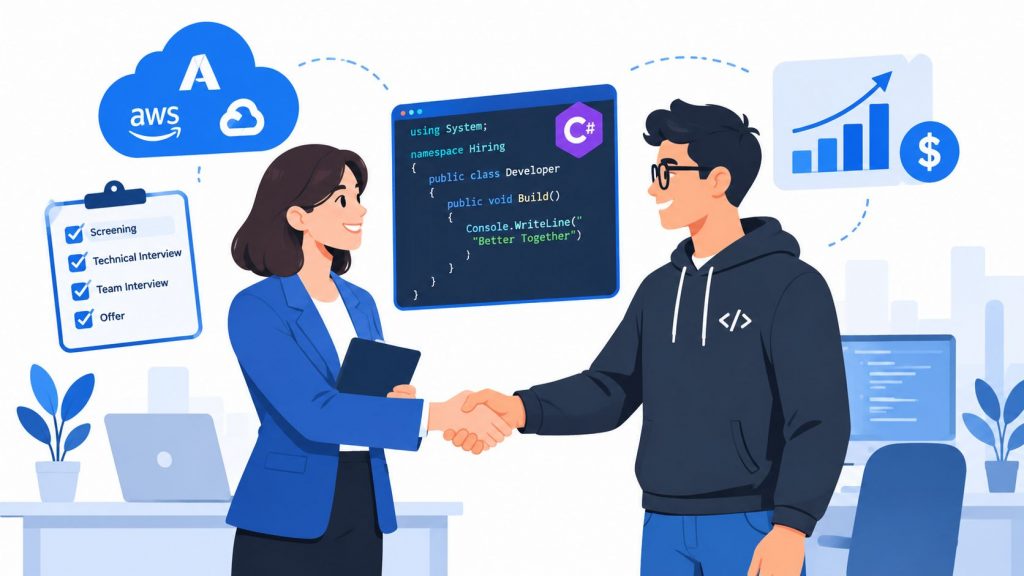



You posted a job on Friday because your patient portal needs attention. By Monday, you've got a pile of résumés, and almost every applicant claims extensive C# experience. Some have maintained older desktop applications. Others have built cloud services. Your practice manager needs reliable scheduling and billing workflows, but the candidates seem to be describing different jobs.
To hire a C Sharp developer successfully, match the engineer to your application's architecture and lifecycle before you compare résumés. Decide whether you need someone to maintain legacy software, modernize it, build a new backend, or manage the platform that runs it. Then test that capability with realistic work, not syntax trivia.
For a U.S. medical practice, there's another decision to make early: whether the developer needs access to patient information. Building a scheduling integration doesn't justify permission to browse production records. Technical hiring and access approval should be separate processes.
A developer also isn't a medical virtual assistant. Appointment schedulers, patient coordinators, insurance verification specialists, and medical billing support staff carry out administrative workflows. An engineer builds or maintains the software those staff members use. Before opening a technical role, confirm that your problem requires software development rather than better staffing, configuration, or training.
The practical approach is straightforward: name the engineering profile, describe the stack, assess delivery judgment, compare complete engagement costs, and establish healthcare access safeguards before onboarding.
Table of Contents
A résumé that says C# tells you the candidate knows a programming language. It doesn't tell you whether they can safely maintain your existing patient portal or deliver a new integration without disrupting appointment scheduling.
C# experience is a starting point, not a job specification. Your hiring decision should identify the runtime, application framework, database, deployment environment, and operational responsibilities involved. Treat these as separate questions rather than one long list of interchangeable technologies.
Ask your current vendor or technical lead for an application inventory before you post the job. Distinguish legacy .NET Framework and classic ASP.NET work from ASP.NET Core applications running on modern .NET. If the documentation says .NET Core, confirm the actual target framework rather than assuming the label tells you its current support status.
C# can describe work across web APIs, enterprise applications, cloud services, desktop tools, healthcare integrations, and games. Résumés mentioning Blazor, Unity, Xamarin, or Azure therefore need context: what did the person build, deploy, troubleshoot, and maintain? For a practice hiring around an appointment API, unrelated application experience shouldn't outweigh demonstrated backend delivery.
Build your inventory around:
Ask candidates how they would keep the application supportable after the immediate project ends. Microsoft's modern .NET support policy distinguishes LTS support of three years from STS support of two years, and requires supported systems to remain current on released patches.
That makes version planning a hiring criterion, not an administrative detail. A candidate should explain dependency checks, test coverage, rollback, and how the practice will know an upgrade worked.
Practical rule: Don't advertise for “C# experience” when the real requirement is “keep our existing application stable while preparing a supported migration.”
Choose the profile that matches that responsibility. A strong maintenance engineer and a strong cloud-platform engineer can both be valuable, but they solve different problems.
Use these four profiles as a hiring decision framework, not rigid labels. Candidates can overlap, especially in smaller teams, but you still need to identify the responsibility that matters most.
For an existing .NET Framework application, look for someone comfortable reading unfamiliar code, tracing database dependencies, and making restrained changes. Your assessment might involve classic ASP.NET, Windows Services, IIS configuration, or stored procedures, depending on what your system uses.
Good looks like a candidate who first establishes how the application behaves and where it fails. In an illustrative patient-portal maintenance role, they should investigate a broken appointment display without proposing an immediate rewrite. A mismatch is someone who dismisses the old stack but can't explain how to stabilize it.
This engineer needs confidence on both sides of a migration. Ask them to assess a .NET Framework application, choose a supported modern .NET target, identify incompatible dependencies, and propose an incremental transition.
For example, a practice replacing an older scheduling application needs protection against lost appointments and inconsistent records, not merely a new project that compiles. Strong candidates explain compatibility testing, staged cutover, and rollback. Be wary of proposals to containerize everything or split a monolith without a clear operational reason.
For a new service, assess ASP.NET Core, API design, testing, authentication, authorization, and database performance. Your selected stack might include minimal APIs, Entity Framework Core, and SQL Server or PostgreSQL.
Consider a new telehealth scheduling API. The right candidate explains appointment availability, concurrent booking requests, integration failures, and maintainable boundaries. A mismatch is someone who can produce endpoints quickly but leaves business rules, error handling, and verification to somebody else.
Choose this profile when deployment and operation are the primary problems. Assess the cloud environment you use, whether Azure or AWS, alongside CI/CD, observability, infrastructure-as-code, and container orchestration where relevant.
An illustrative multisite healthcare organization might need repeatable releases and clearer incident diagnosis across several services. A platform specialist should connect infrastructure choices to recovery and support needs. Don't require Kubernetes merely because it appears on impressive résumés; ask what problem it would solve.
The checklist below can help translate the selected profile into a hiring process.

Before posting, finish this sentence: We need this engineer primarily to maintain, modernize, build, or operate our application. If you can't choose, clarify the project before interviewing.
Write the description around deliverables and ownership. Specify the target .NET release, ASP.NET Core requirements, Entity Framework Core if applicable, SQL Server or PostgreSQL, cloud target, testing expectations, and release responsibilities. Put optional technologies in a separate category rather than creating an impossible all-purpose role.
A sample IT job description can provide a drafting structure, but replace generic responsibilities with your practice's actual work. Describe whether the engineer reports to a technical lead, coordinates with an EHR vendor, or must explain changes directly to a practice manager.
State working-hour overlap, communication requirements, equipment arrangements, and who handles urgent incidents. Publish the approved compensation range, but don't copy an unsourced market estimate into your offer.
For broader sourcing and engagement questions, Blockchain Jobs' guide to hiring remote developers is a supplementary resource. Keep your own evaluation specific to .NET delivery and medical-practice workflows.
Use the checklist as a planning aid rather than a fixed interview script.

Start with a communication screen. Ask candidates to describe their own contribution to a relevant project and explain a technical problem in language a practice manager could understand. Follow with a time-boxed work sample and a structured design conversation, using the same core questions for comparable finalists.
For a backend role, use synthetic appointment data and ask the candidate to implement an authenticated REST endpoint, validation, cancellation handling, tests, and a short deployment note. Adapt the exercise for maintenance or platform roles rather than forcing every applicant through the same backend task.
The discussion of work samples and structured technical interviews reports predictive-validity coefficients of approximately 0.54 for work-sample tests and 0.51 for structured interviews. These aren't hiring guarantees; they support using job-representative evidence rather than résumé keywords alone.
Use a prepublished scorecard:
| Review area | Evidence to look for |
|---|---|
| Correctness and maintainability | Clear behavior, understandable code, appropriate exception boundaries |
| Asynchronous execution | Sound async/await use and cancellation-token propagation |
| Dependencies and persistence | Appropriate dependency injection lifetimes and efficient queries |
| Security | Deliberate authorization policies and protected credentials |
| Testing | Isolated tests covering failures as well as successful requests |
| Communication | Clear trade-offs, limitations, and deployment assumptions |
Don't reward algorithm memorization or accept untested code because it looks polished. Keep the exercise fictional, not an unpaid production deliverable, and have reviewers record evidence before discussing their impressions.
Budget for ownership, not just coding hours. A medical practice needs to know who will review changes, maintain documentation, respond when an integration fails, and support the application after the initial engagement.
There isn't a defensible universal hourly rate to apply across these models without comparable quotes. Ask suppliers to price the same profile, scope, working-hour overlap, and support obligations. Treat a quoted rate as incomplete until you understand what it includes.
| Model | Typical hourly rate (USD) | Time to start | Best for |
|---|---|---|---|
| In-house full-time | Calculate from an actual offer and employer costs | Depends on recruitment and notice periods | Continuing product ownership with internal management |
| Staff augmentation | Obtain a role-specific supplier quote | Depends on candidate availability and onboarding | Adding engineering capacity to an existing technical team |
| Nearshore dedicated team | Quote the team and included management | Depends on staffing and access readiness | Coordinated delivery where working-hour overlap matters |
| Freelance marketplace | Candidate-specific quote or project price | Depends on availability and screening | Bounded tasks with clear review and acceptance criteria |
An in-house employee may suit ongoing responsibility, but employment alone doesn't supply technical oversight. Staff augmentation works when your organization can direct and review the engineer's work; it's a poor substitute for architecture leadership when nobody internally can evaluate the result.
A nearshore team may offer useful overlap with U.S. working hours. Verify the actual schedule and language skills instead of treating geography as proof. A freelancer can be appropriate for a contained task, but define handover and post-delivery support before accepting the price.
Use software development outsourcing cost considerations to organize the commercial questions. Your quote comparison should distinguish:
The cheaper quote isn't cheaper if your practice manager must become the project manager, tester, and incident coordinator.
Keep regulated staffing arrangements separate from ordinary software sourcing. If your organization also works on public-sector engagements, erecruit's discussion of a government staffing agency provides adjacent staffing context, not a C# rate benchmark or healthcare compliance authority.
Finally, match the commercial arrangement to the profile. Don't pay for advanced platform expertise to handle routine maintenance unless that capability is required, and don't ask a maintenance contractor to own a cloud migration without assessing it.
AI familiarity isn't evidence of engineering maturity. In Stack Overflow's 2025 developer survey, 84% of respondents said they were using or planning to use AI development tools, compared with 76% the previous year. Those figures describe adoption intentions and use, not competence.
My recommendation is to permit AI in a controlled assessment and test whether the candidate remains accountable for the result. Faster code generation doesn't excuse weak architecture, missing authorization, or an inability to debug.
Use the fictional work sample already defined, with synthetic records and no production credentials. Tell candidates what assistance is permitted and require them to identify where they used it. Don't allow access to patient information or confidential practice material during the exercise.
A developer skills assessment framework can help organize the evaluation, but make the discussion about the candidate's reasoning rather than the apparent sophistication of their output.
The visual below highlights the healthcare responsibilities that still apply when development tools assist with the work.

Ask the candidate to inspect their implementation, explain the decisions, and respond to a changed requirement. For an appointment endpoint, you might introduce a request involving another patient's booking or a database timeout. The exercise is illustrative, not a real practice incident.
Score the following:
Don't reject a candidate for using AI, and don't advance one because the output looks complete. A strong engineer can explain what they accepted, what they changed, and what they still need to verify.
Hiring boundary: Code the candidate can't explain or validate isn't evidence that they can own the application.
The distinction matters especially when a nontechnical practice manager will rely on that person's judgment after hiring.
A technically capable developer doesn't make a practice's environment compliant. HHS states that HIPAA access-control safeguards apply to telecommuting workers accessing ePHI. Working remotely doesn't remove those obligations.
Approve the role's access before issuing credentials. Identify whether the engineer needs repositories, staging systems, logs, backups, or production access, and whether any of those contain electronic protected health information.
HHS's technical safeguards guidance identifies unique user identification and emergency access procedures as required specifications. Automatic logoff and encryption/decryption are addressable specifications, meaning the practice must make and document reasonable, appropriate risk-based decisions rather than treat them as optional checkboxes.
For your hiring and onboarding plan, specify individual accounts, role-based permissions, authentication, meaningful audit logging, secure devices, and secrets management. Evaluate encryption at rest and in transit and session controls with your compliance and technical advisers. Don't present a particular VPN, tool, or candidate as sufficient proof of compliance.
The diagram is a hiring aid, not a certification standard.

HHS's remote-use risk-management guidance calls for analysis of remote-access risks and access limited to trained, authorized users according to organizational role and need.
My recommended default is development with synthetic or appropriately de-identified data. Repository access may be necessary, but inspect repositories for embedded secrets or patient information first. When production troubleshooting is justified, use approved, time-limited access with logging and documented supervision rather than permanent administrator privileges.
A developer repairing a billing job might need error details and execution traces, not unrestricted patient records. Check whether logs themselves expose identifiers before treating them as harmless.
Ask practical questions:
A larger organization may already have security and engineering reviewers. A small practice may need outside expertise before granting sensitive access. Document the employment or vendor relationship, covered systems, access approver, training, and revocation process, and confirm applicable contractual and compliance obligations with qualified advisers.
To hire a C Sharp developer, start with the responsibility: legacy support, modernization, greenfield backend, or platform engineering. Put the actual stack and expected deliverables into the job description, then assess realistic work with consistent questions and an evidence-based scorecard. Reject candidates who can't explain their implementation, test failure paths, or respect access boundaries.
Choose an engagement model your practice can supervise, and compare complete quotes rather than unsupported hourly averages. Permit controlled AI assistance, but keep engineering accountability with the candidate. Before onboarding, approve the data-access scope and document the safeguards, reviewer responsibilities, and offboarding process.
If you need help assembling a shortlist, consider HireDevelopers.com alongside direct recruitment and specialist contractors. It offers vetted nearshore and offshore engineers, multi-stage technical assessment, flexible month-to-month engagements, and no deposit. Bring a clear profile, stack inventory, and access plan to the initial conversation.

Learn the essential tips for hiring developers for startup success. Discover sourcing, interviewing, and closing talent without overspending.


Let's be honest. The buzz around Flutter is impossible to ignore, and you're here trying to figure out if hiring a Flutter developer is a brilliant move or just another way to burn through your runway. It's a fair question. The right tech stack feels like a growth hack; the wrong one feels like an...

Most SQL interview processes are broken because they reward the wrong behavior. A candidate memorizes the difference between DELETE and TRUNCATE, recites it on cue, and walks out looking sharp. Meanwhile, nobody has learned whether they can untangle a messy join, explain a bad execution plan, or keep a reporting query from chewing through your...


