Hire Android Coder

Victor
Posted on 2 October 2026
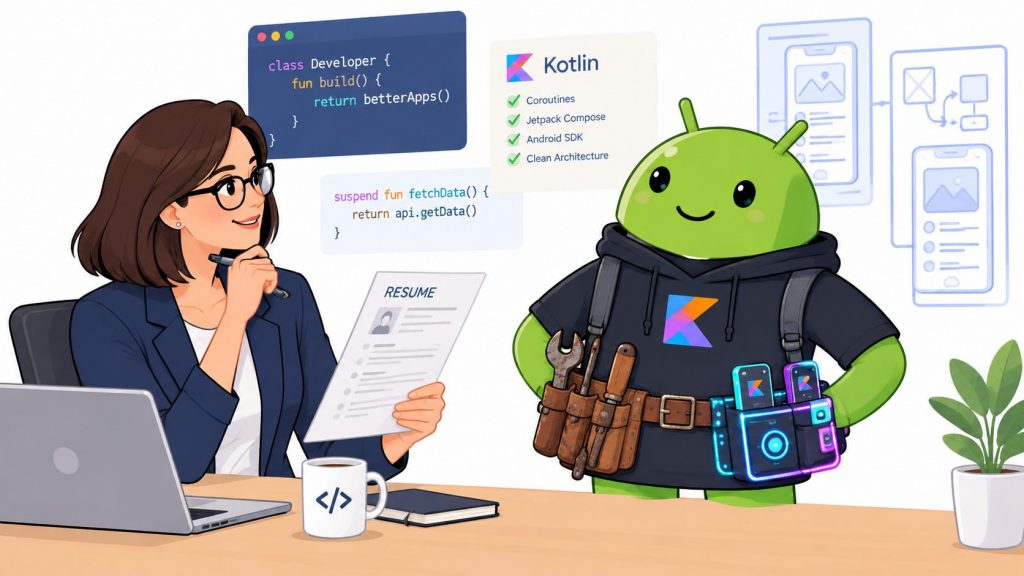



The most common advice when you hire an Android coder is to prioritize years of experience and a long list of shipped projects. That advice is incomplete. A developer can have several years of Android work behind them and still be poorly prepared for a Kotlin-first, Jetpack Compose codebase.
For U.S. medical practices and healthcare organizations, the distinction matters. A mobile app may support patient scheduling, secure messaging, intake, remote monitoring, or staff workflows. The engineer must understand Android architecture, lifecycle behavior, testing, release ownership, and the privacy implications of handling sensitive information. This guide explains how to separate legacy Java maintenance experience from current Android delivery skills, inspect real portfolio evidence, design practical interviews, and choose an engagement model that fits your product and budget.
Table of Contents
A résumé that says “Android Developer” doesn't tell you enough. Android has a long history, a large installed base, and a wide range of codebases in production. Google acquired Android Inc. in July 2005, the public beta launched on November 5, 2007, and Android 1.0 debuted on September 23, 2008 with the HTC Dream, also known as the T-Mobile G1, as the first commercial device. By 2011, Android had become the world's most popular mobile operating system, and in April 2018 it held 75.66% global market share, compared with 19.23% for iOS, according to this history of Android's evolution.
That history creates both opportunity and confusion. Android teams still maintain applications built around Java, XML layouts, older support libraries, and Activity-heavy designs. Other teams are building with Kotlin, Jetpack Compose, coroutines, Flow, and modern Jetpack components. Both candidates may describe themselves as Android engineers, but they don't necessarily offer the same delivery capability.
A candidate with five years of Android experience may have five years of growth, or one year of experience repeated five times. The difference appears in the work they can explain. Have they migrated a screen from XML to Compose? Have they modeled UI state explicitly? Can they describe how coroutine cancellation behaves when a screen leaves the composition or lifecycle? Have they dealt with offline data, process death, configuration changes, and failed network requests?
These aren't academic questions. A healthcare application that loses a partially completed intake form during rotation or mishandles a background request can create operational problems for patients and staff. A developer who has only maintained stable legacy screens may struggle when asked to design a new workflow with asynchronous data, accessibility requirements, and unreliable connectivity.
The market itself is large, but volume doesn't remove the screening problem. One tracked dataset recorded 205 Android-related postings in August 2026, with Mobile Engineer appearing in 63% of those postings. Broader 2026 labor-market data cited more than 26,458 Android developers employed in the United States and 237,147 active Android developer openings, with projected Android developer demand growth of 21% from 2018 to 2028, as reported in this Android skills market overview. Those figures describe market activity, not candidate quality.
Practical rule: Treat “Android experience” as a starting category, not a qualification. Ask what the person has built, with which tools, and what they personally owned after release.
Founders and practice managers don't need to become mobile architects to avoid this trap. They do need a consistent review process that tests current ecosystem knowledge instead of rewarding résumé length. A structured approach, such as the Hiring Review resources for founders, can help nontechnical decision-makers document requirements, interview evidence, and hiring risks before comparing candidates.
Demand for software engineers remains broad, as discussed in this overview of whether software engineers are still in demand. The practical implication is simple: if your role description says only “Android developer” and “Java or Kotlin,” you'll attract a mixed pool and make the evaluation harder than it needs to be.
Java knowledge still has value. Many Android applications contain Java code, and a developer may need to debug interoperability issues, understand an older SDK integration, or contribute safely to a gradual migration. The mistake is treating Java familiarity as proof of modern Android competence.
Kotlin changes how developers express nullability, data models, extension behavior, and asynchronous work. Jetpack Compose changes how they construct interfaces and reason about state. Compose isn't a replacement for XML files. It encourages a declarative model in which the UI reflects state, and the developer must decide where that state lives, how it changes, and how the screen responds to it.

| Area | Legacy Java and XML emphasis | Modern Kotlin and Compose emphasis |
|---|---|---|
| UI construction | Views, XML layouts, adapters, and imperative updates | Composable functions, state, recomposition, and reusable UI components |
| Asynchronous work | Callbacks, threads, and manually managed handlers | Coroutines, structured concurrency, and Flow |
| Architecture | Activity or Fragment classes carrying broad responsibilities | Clear state holders, ViewModels, repositories, and testable boundaries |
| Migration needs | Maintenance of established screens and dependencies | Incremental modernization without breaking existing behavior |
| Interview evidence | Familiarity with syntax and Android APIs | Reasoning about lifecycle, state, cancellation, testing, and production trade-offs |
The strongest candidate may know both columns. A healthcare organization with an established app doesn't need someone who dismisses legacy code. It needs an engineer who can decide what to preserve, what to isolate, and what to modernize first. Ask the candidate to describe a migration they contributed to, including what they left unchanged and why.
Some developers translate Java syntax into Kotlin without adopting idiomatic Kotlin practices. Their code may compile, but it often contains excessive mutable state, unnecessary scope functions, weak null handling, and coroutine usage that isn't tied to a clear lifecycle. They may mention Kotlin prominently while struggling to explain suspend functions, cancellation, Flow collection, or the difference between a cold stream and a state holder.
A practical interview prompt is to give the candidate a screen that loads patient appointment data, displays loading and error states, and allows a retry. Ask them to outline the state model and explain where the network request belongs. You aren't looking for one approved architecture. You're looking for separation of concerns, lifecycle awareness, predictable state transitions, and an explanation a product manager can follow.
Ask whether the candidate has used Compose in production, but don't stop at the tool name. Explore how they handle recomposition, hoist state, build reusable components, test UI behavior, and integrate Compose into an existing XML application. A candidate who has only followed tutorials may describe syntax. A production engineer will discuss design decisions, accessibility, previews, navigation, performance investigation, and the boundaries between UI and domain logic.
Google reported that more than 95% of the top 1,000 Android apps contain Kotlin code, while Jetpack Compose adoption is reported at above 40% and accelerating, according to this Android staffing guide focused on Kotlin and Compose. These figures shouldn't become a rigid hiring filter for every role. They should signal that modern stack experience is now a material part of the market, especially for new product work.
If you want examples of products built with Kotlin, you can explore top Kotlin apps, but portfolio review still matters more than brand recognition. A candidate who can explain their own technical decisions is more valuable than one who merely lists familiar application names.
Résumés describe responsibilities. Shipped applications reveal constraints. When evaluating an Android coder, ask for a portfolio walkthrough that focuses on one application the candidate knows inside out, rather than a rapid tour of every project listed on the résumé.
Start with the Google Play listing, if the application is public. Look at whether the app appears maintained, whether the interface behaves coherently across its main flows, and whether the candidate can explain changes visible in recent releases. You aren't trying to judge the app as a consumer or infer private performance data. You're checking whether the candidate understands what reached users and what happened after release.

Ask the candidate to choose one feature and explain five points:
The answers should become more specific as you probe. “I worked on the appointment module” is a responsibility. “I changed the state model so a failed verification request could be retried without duplicating the submission” is evidence of reasoning.
A public GitHub repository can show structure, but it shouldn't be treated as a complete representation of professional work. Confidential production code often can't be shared, and a small open-source project may not reflect the candidate's normal team environment.
Look for readable boundaries rather than fashionable folder names. MVVM or MVI can both work when the candidate explains why the pattern fits the product. Useful signals include ViewModels that don't directly own UI rendering, repositories with clear data responsibilities, sensible module boundaries, testable business rules, and Compose components that don't hide networking or persistence inside UI functions.
Red flags deserve questions, not automatic rejection. A large Activity class, extensive XML, or Java code may reflect a legacy product rather than weak engineering. The concern is whether the candidate can explain the constraints, identify risks, and work incrementally. A developer who says “the old code is bad” without proposing a safe migration plan is less useful than one who can improve a constrained system without interrupting patient or staff workflows.
A portfolio should answer one question clearly: can this person explain how a real feature moved from design to release, including the parts that failed?
For comparison, the same evidence-first principle applies when teams hire a Vue.js developer. Framework familiarity matters, but ownership, shipped work, and the ability to discuss trade-offs are stronger signals than a list of technologies.
A standard algorithm exercise can reveal useful problem-solving habits, but it shouldn't carry the interview. Android development involves lifecycle behavior, asynchronous work, platform variation, UI state, release risk, and communication with designers, backend engineers, support teams, and product owners.
A better process uses several smaller signals. The candidate first discusses a shipped feature, then completes a focused practical task, then reviews the design with an engineer. This structure gives you a clearer view of both coding ability and judgment without turning the interview into an unpaid product project.

Give the candidate a bounded feature, such as an appointment list that reads from a mock API, displays loading and error states, supports retry, and retains the last successful result for offline viewing. For a medical practice, the exercise can use fictional data and must not include real patient information.
Ask for Kotlin and a modern UI approach when that reflects your planned codebase. The assignment should evaluate:
Keep the scope narrow enough that you evaluate decisions, not endurance. A task that requires a full application, elaborate design system, or production infrastructure encourages candidates to spend time polishing the wrong things.
Use the follow-up to change the conditions. Ask what happens if the screen rotates during a request, the process is killed and restored, the user taps retry repeatedly, or the device loses connectivity after receiving part of a response. In a healthcare workflow, ask how the candidate would prevent a duplicated appointment request or make it clear that displayed data may be outdated.
Then inspect the code together. Ask the candidate to change one requirement, such as adding pagination or separating appointments by status. Strong engineers can explain what would change and what should remain stable. They don't need to defend every line, but they should recognize coupling and identify where tests would protect the modification.
The Android developer interview guidance supports evaluating shipped apps, platform depth, modern Kotlin and Compose skills, release ownership, testing, monitoring, support, and communication. Those categories match the work that continues after the first successful build.
| Competency | Strong evidence | Concern |
|---|---|---|
| Kotlin | Uses coroutines, Flow, null safety, and extensions deliberately | Kotlin appears mainly as renamed Java |
| Compose | Explains state, recomposition, testing, and incremental adoption | Discusses only syntax or visual styling |
| Android platform | Understands lifecycle, permissions, background work, and compatibility | Treats the device as a uniform runtime |
| Production ownership | Can discuss releases, monitoring, defects, and support | Stops at implementation |
| Communication | Explains trade-offs to technical and nontechnical people | Gives unexplained preferences or vague answers |
Use the same scorecard for every candidate. That reduces the chance that an impressive résumé or highly polished conversation outweighs missing evidence.
The cost of hiring an Android coder depends on more than geography. Seniority, modern-stack depth, remote autonomy, product complexity, and the amount of legacy code all affect the offer a candidate will consider. A low hourly rate can become expensive if the engineer creates fragile architecture that another developer must later replace.
Recent salary sources illustrate the spread. One 2026 source places average U.S. Android developer pay at about $109,671, while another reports remote Android roles at about $127,151 annually and senior fully remote roles reaching about $149,714 in one market guide. The figures come from different methodologies, so they shouldn't be treated as a universal salary band. They do show why a single budget number can misprice the role, especially when you require Kotlin, Compose, production ownership, and remote communication. See the Android developer salary guide for the source context.
A separate benchmarked hiring workflow lists 30 to 45 days as a planning range for time to fill, 8% to 12% of annual compensation as a cost-per-hire benchmark, and 75% to 85% offer acceptance. The same funnel moves from 1,000 resumes screened to 8 hires, a 0.8% final hire rate from the initial pool. Those figures come from one published workflow, not a promise for every employer, but they demonstrate how quickly a broad search can consume management time when the role lacks clear technical requirements. The Android developer job description benchmark provides the full funnel.
| Engagement Model | Typical Cost Profile | Time to Onboard | Best Use Case |
|---|---|---|---|
| Full-time employee | Highest ongoing commitment, with compensation and employment overhead | Slower because the role requires a complete hiring process | Core product ownership and long-term roadmap work |
| Independent contractor | Flexible project spending, with a higher need for clear scope and handoff planning | Often faster when the specialist is available | Defined features, migrations, or temporary capacity |
| Nearshore dedicated engineer | Variable market pricing, with coordination and management still required | Faster when a qualified shortlist already exists | Remote product work needing working-hour overlap |
| Development agency | Bundled team and delivery cost, with less direct control over individual staffing | Can begin quickly if the agency has capacity | A defined project where internal mobile leadership is limited |
Remote hiring expands access, but it doesn't remove the need to assess communication, security practices, and release ownership. A senior engineer working remotely should be able to document decisions, escalate risks early, and coordinate with backend and clinical operations teams without constant supervision.
For a medical practice, the engagement decision also intersects with privacy. If a remote worker or vendor outside the practice's workforce accesses protected health information on the practice's behalf, HHS treats that party as a business associate and requires a written business associate contract or other arrangement defining the work and requiring protection of PHI. The HHS guidance for covered entities and business associates explains that the trigger is the relationship and access to PHI, not whether the person works remotely.
HHS also distinguishes contractual assurances from day-to-day micromanagement. A covered entity must enter a written contract with a business associate and obtain satisfactory assurances, but it isn't required to monitor every internal method the vendor uses to carry out privacy safeguards. The HHS business associate FAQ explains that the Security Rule applies to business associates as well.
Before access is granted, define what data the coder can see, where test data comes from, how credentials are handled, and who approves production releases. The HHS business associate guidance defines business associates broadly enough to include outside people or entities handling PHI-related services, while the HIPAA Security Rule overview describes administrative, physical, and technical safeguard obligations. Practices should confirm their specific arrangement with qualified compliance or legal counsel.
When deciding whether to hire a developer directly or use another delivery option, a practical comparison of whether you should hire a developer can help clarify the product's actual need. Also account for technical debt, knowledge transfer, code review, and ongoing ownership when comparing offers. The apparent bargain is rarely a bargain if the person cannot maintain the application after launch.
For a broader view of outsourcing economics, review this guide to software development outsourcing costs. The right model is the one that gives your team enough Android expertise to make sound decisions, not just the one with the lowest initial quote.
To hire an Android coder successfully, look past the job title and the number of years on the résumé. Android's long platform history means many capable developers have worked on Java and XML systems, but a current product may require Kotlin, Jetpack Compose, coroutines, Flow, lifecycle awareness, testing, release operations, and migration judgment.
Review one shipped feature in depth. Ask what the candidate owned, how the feature handled failure, what changed after release, and how the architecture would respond to a new requirement. Then use a small, realistic task with fictional data and a structured scorecard. For a healthcare organization, include privacy boundaries and access controls in the delivery discussion before anyone touches PHI.
Price the role according to the capability you need. A senior remote engineer who can work independently on a modern codebase won't fit the same budget as a developer assigned to straightforward legacy maintenance. Choose full-time, contract, nearshore, or agency support based on product continuity, scope, internal leadership, and the amount of technical risk you can absorb.
If you're ready to start, write a role brief that names your current architecture, Kotlin and Compose expectations, release responsibilities, working hours, and healthcare data boundaries. Then speak with a specialized talent partner or run the portfolio and practical interview process directly, and don't advance a candidate until they can demonstrate modern Android judgment with evidence from real work.

Learn how to optimize website performance effectively. Boost speed, user experience, and SEO with our expert tips. Click to discover how!


When people talk about "python development services," they're not just talking about hiring a coder. They're talking about bringing in a strategic partner to translate a business goal into clean, scalable software. It’s about finding an expert who can do everything from building backend APIs and data scripts to engineering complex AI models. Think of...

Stop getting unqualified applicants. Learn how to write a SQL developer job description that attracts top database talent with our proven tips and examples.


