8 Embedded Systems Engineer Interview Questions

Victor
Posted on 23 September 2026
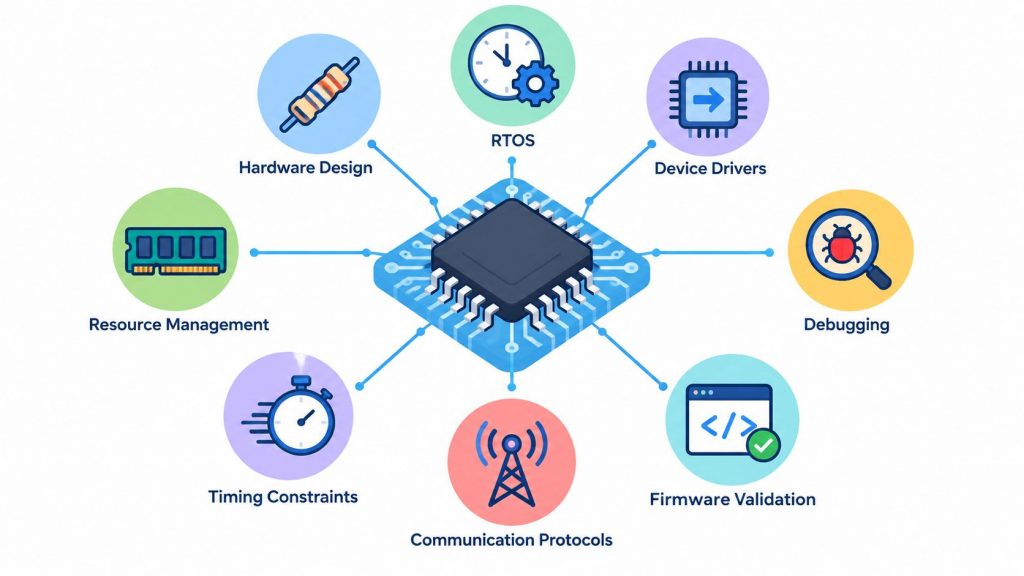



65% of leading embedded systems companies struggle to fill key roles, and the semiconductor industry is projected to face a shortage of 1.5 million skilled workers over the next five years. The strongest embedded systems engineer interview questions test eight areas, hardware, architecture, RTOS and debugging, security, testing, domain standards, communication, and remote collaboration, then use sample answers and evidence-based scoring to distinguish practical engineers from candidates who only know definitions.
What gap does a conventional interview miss when a candidate can explain volatile perfectly but can't show how they found a timing fault on a real board? Effective embedded systems engineer interview questions reveal whether someone can reason from datasheets, design around timing and resource limits, debug hardware-software interactions, validate firmware, and communicate decisions clearly.
The eight categories below work best as an adaptable evaluation framework, not a memorized question bank. Difficulty should match the role's seniority, and each prompt should reflect the target architecture, RTOS, product risk, and available hardware access. A junior candidate may need to explain a register or interrupt path. A senior candidate should defend a platform decision, quantify trade-offs qualitatively, and describe how the decision would survive production failures.
Sample answers are benchmarks, not scripts. Strong candidates may use different tools or architectures and still demonstrate sound reasoning. For remote evaluation, ask for diagrams, pseudocode, logs, design notes, or a recorded walkthrough where appropriate. A structured predictive interview framework can help hiring teams assess likely job performance rather than reward polished improvisation. Medical, automotive, aerospace, and other regulated products also require domain-specific follow-up.
Table of Contents
Difficulty: foundational to advanced
An embedded engineer has to understand the boundary between code and silicon. Ask, “How would you explain the memory layout of a Cortex-M4, and how might you reduce interrupt latency for a medical monitor sampling at 1 kHz?” A strong answer should distinguish flash, SRAM, stack, heap, memory-mapped peripherals, interrupt vectors, and any relevant memory protection features. It should then connect latency to interrupt priorities, handler length, critical sections, cache or bus effects where applicable, and the need to measure rather than guess.
The answer doesn't need to follow one textbook design. It does need to show that the candidate understands why a long interrupt service routine, excessive locking, or unnecessary register access can interfere with deterministic behavior. For a medical monitor, follow up by asking how they would verify that sampling remains reliable under maximum interrupt load and how they would document the assumption.
Ask the candidate to configure a clock tree on an STM32 microcontroller while meeting a power constraint. A capable engineer will start by clarifying clock accuracy, peripheral frequencies, wake and sleep behavior, timer requirements, and acceptable performance degradation. Watch for a clear distinction between the nominal configuration and the measurements needed on the actual board.
A second useful prompt is, “An SPI bus connects several peripherals. How do you reason about clock polarity, phase, maximum frequency, setup and hold timing, and slave-select behavior?” Strong candidates discuss device-specific timing, bus ownership, chip-select sequencing, DMA trade-offs, electrical loading, and what they would inspect with a logic analyzer. They won't assume that a bus works because a driver returns success.
Practical rule: Give candidates a short datasheet excerpt and ask them to explain one register field, its reset value, legal combinations, and the failure modes created by a wrong setting.
For remote candidates, provide a sanitized register page or memory map before the call. Ask them to annotate it and explain their reasoning. Request a walkthrough of a past board bring-up, including what failed, which hypothesis they tested first, and whether they used a JTAG debugger, oscilloscope, or logic analyzer. A candidate who reaches immediately for observable evidence is usually safer than one who proposes repeated code changes without isolating the electrical layer.
The distinction between firmware and hardware ownership also matters. Ask what they would do if a GPIO reads the wrong level intermittently. A good answer separates software configuration, pin multiplexing, pull resistors, voltage levels, grounding, signal integrity, and probe technique. For broader practice, compare these prompts with electrical engineering interview questions, then adapt them to the exact MCU and peripherals your team uses.

Difficulty: intermediate to advanced
A candidate's debugging method often tells you more than a correct definition of an RTOS term. Ask, “A task occasionally misses its deadline. How would you find the root cause?” Strong candidates establish a reproducible condition, identify the deadline and scheduling assumptions, instrument task execution, inspect interrupt load, check blocking calls and priority relationships, and correlate firmware events with external signals.
They should be able to explain the difference between deadlock and priority inversion without stopping at vocabulary. A deadlock means tasks can remain permanently blocked by a cycle of resource dependencies. Priority inversion occurs when a higher-priority task is delayed by lower-priority work, often through a lock held by a lower-priority task. A strong follow-up is to ask about priority inheritance, bounded critical sections, lock ordering, and whether the design can avoid shared mutable state altogether.
Give the candidate a short code sample with a race condition and ask how they would detect it without running the code. Look for attention to interrupt context, atomicity, ownership, compiler reordering, memory visibility, and the difference between a variable being declared volatile and an operation being thread-safe. A weak answer treats volatile as a universal synchronization mechanism.
For a hard fault on an ARM Cortex-M, ask them to use a JTAG debugger to inspect the stacked registers, program counter, link register, fault status registers, active tasks, and stack usage. The candidate should discuss preserving fault context and distinguishing stack exhaustion, invalid memory access, corrupted return addresses, and peripheral misuse. They don't need to know your exact debugger interface, but they should have a disciplined path from symptom to evidence.
Intermittent faults become manageable when the engineer can turn timing into observable data.
Ask how they would align GPIO transitions with RTOS context-switch events using a logic analyzer. Then probe their approach to deterministic testing. Can they control inputs, scheduling pressure, interrupt frequency, and power conditions well enough to reproduce the issue? Have they added production telemetry for task timing, queue depth, reset causes, or resource exhaustion?
Tool familiarity should be discussed in context. A candidate may have used FreeRTOS heap analysis, ThreadX event logging, or Wind River tools for VxWorks. The name matters less than whether they can explain what the tool measured, what it couldn't reveal, and how the evidence changed the implementation. For remote teams, request a written incident summary. It should include the observed failure, hypotheses, experiments, root cause, corrective action, and a regression test.

Difficulty: intermediate to advanced
Architecture questions should force candidates to choose under constraints. Give them a battery-powered glucose monitor that must operate for 90 days and synchronize data every six hours. Ask for the subsystem boundaries, communication paths, storage approach, security model, update strategy, and power budget assumptions.
A strong candidate will ask clarifying questions before drawing boxes. They may ask about measurement frequency, wireless technology, data retention, fault behavior, regulatory expectations, manufacturing volume, available sensors, and whether the device can be serviced physically. That behavior matters. Engineers who begin with a favorite MCU or protocol before clarifying constraints may produce an elegant design for the wrong product.
Listen for explicit trade-offs among power consumption, memory footprint, latency, reliability, cost, maintainability, and lifecycle support. A mesh network may improve coverage but increase complexity and power use. A star topology can simplify coordination but create dependency on a central node. Cellular connectivity may reduce local infrastructure requirements while increasing modem power, certification, and operating dependencies.
Ask the candidate to compare centralized state in a master microcontroller with distributed intelligence on edge nodes. Neither answer is automatically correct. The useful evidence is whether they define ownership, failure boundaries, synchronization, recovery behavior, and testability.
A second prompt should address firmware updates. “How would you design an update mechanism that maintains security and reliability while minimizing downtime?” Expect discussion of image authenticity, version control, rollback policy, interrupted transfers, bootloader state, power loss, compatibility, staged deployment, and recovery. A candidate who says only “use signed firmware” hasn't addressed the operational path.
A senior engineer doesn't just draw the happy path. They explain how the device behaves when power disappears halfway through an update.
Ask about a major architectural refactor the candidate led. What constraint forced the change? Which interfaces did they preserve? What did they deliberately leave imperfect to ship on time? Strong answers show a written decision record, migration strategy, and awareness of future maintenance. Warning signs include architecture described as personal preference, no rejected alternatives, or no explanation of how the design was validated.
Standards and reference designs can provide useful scaffolding. ARM CMSIS or automotive AUTOSAR may improve consistency and integration, but they can also add abstraction, tooling, and process overhead. Ask when the candidate would adopt the standard, when they would isolate it behind an interface, and how they would keep the product from becoming dependent on an abstraction nobody can test.
Difficulty: advanced
Security questions should connect threats to design decisions. Ask, “How would you update firmware across a distributed medical device fleet without allowing unauthorized images, unsafe rollback, or a bricked device?” A strong answer covers device identity, authenticated and integrity-protected images, secure boot, key handling, version policy, interrupted downloads, atomic activation, recovery images, observability, and a controlled rollout process.
The candidate should also distinguish product security from regulatory compliance. A secure design doesn't automatically satisfy a medical software lifecycle requirement, and compliance documentation doesn't prove that a device is secure. Ask how threat analysis, requirements, implementation, verification, vulnerability handling, and release evidence connect in their previous work.
Present a connected insulin pump scenario and ask the candidate to identify assets, trust boundaries, threat actors, attack paths, and mitigations. Look for protection of therapy settings, credentials, update mechanisms, communication channels, debug interfaces, logs, and safety-related behavior. Strong candidates discuss availability and safety as well as confidentiality. They should also explain which mitigations belong in hardware, boot code, operating-system configuration, application code, manufacturing, and field operations.
Then ask about cryptographic implementation choices. A general-purpose library may offer mature algorithms and broad review, while a lightweight embedded option may reduce footprint or simplify platform integration. The candidate should ask about hardware acceleration, randomness, key storage, updateability, side-channel exposure, maintenance, and the consequences of selecting an unmaintained dependency. A useful follow-up resource is this guide to cryptography for software development, but the interview should focus on applied judgment rather than library familiarity.
Candidates who've discovered a firmware vulnerability should be able to explain the finding without exposing confidential details. Ask how they reproduced it, assessed severity, contained it, coordinated disclosure, patched affected versions, and prevented recurrence.
For medical products, probe familiarity with FDA expectations, IEC 62304, risk management, and the limits of HIPAA's relevance to the device itself. HIPAA generally governs covered entities and business associates, not every manufacturer or device by default. Ask the candidate to separate applicable obligations from recommended safeguards and to involve qualified compliance professionals when the boundary is uncertain.
Difficulty: intermediate to advanced
Ask the candidate to design tests for a sensor driver that must run against both a mock interface and actual hardware. The best answers define the driver contract first, isolate hardware-dependent code, test normal and malformed inputs, simulate timeouts and invalid readings, and reserve hardware tests for behavior that mocks cannot represent.
A candidate should also explain what unit tests cannot prove. A driver can pass mocked tests while using the wrong register sequence, violating electrical timing, mishandling DMA ownership, or failing under reset conditions. Strong engineers build a layered plan that combines unit, integration, hardware-in-the-loop, system, fault-injection, and release validation.
Ask how they would create a firmware CI pipeline. Look for reproducible toolchains, static analysis, compiler warnings, unit tests on the host, target builds for relevant variants, artifact retention, binary metadata, and a clear policy for hardware-dependent tests. If the candidate proposes coverage as a gate, ask what the metric excludes and how they prevent teams from writing superficial tests to satisfy it.
For a PID control loop, ask how they would test timing-sensitive behavior without the final hardware. Good answers may include a simulated plant model, deterministic time source, host-side tests, processor-in-the-loop testing, hardware-in-the-loop testing, and later correlation against measured signals. The engineer should explain which assumptions require confirmation on the target.
A test plan earns trust when each test has a failure it can detect and a decision it can support.
Give the candidate a failed-sensor scenario. The system should detect the fault, avoid unsafe output, record useful diagnostics, and recover or enter a defined safe state. Ask how they would verify behavior across startup, normal operation, communication loss, sensor drift, reset, and power interruption.
Remote candidates should be able to show how their test evidence travels with a change. Ask them to describe a bug that a test caught, a bug that escaped, and the adjustment that followed. Their answer should reveal whether testing is treated as a delivery responsibility or pushed to a separate group. A practical companion is this guide to debugging and testing, especially when designing a remote evaluation exercise.
Difficulty: role-dependent
A candidate doesn't need every industry standard on their résumé. They do need to understand how the target domain changes engineering work. Ask what standards they have used directly, which process artifacts they created, and what technical decision changed because of those requirements.
For medical firmware, ask how IEC 62304 experience affected lifecycle planning, traceability, risk analysis, verification, configuration management, and change control. For automotive work, ask about AUTOSAR architecture, ASPICE practices, ISO 26262 functional safety, and CAN communication. For industrial control systems, ask about IEC 61131-3 languages, deterministic control behavior, fault response, and integration with existing plant systems.
A strong candidate can describe a review, audit, submission, or verification activity in concrete terms without claiming ownership they didn't have. Ask what evidence was requested, which gap surprised the team, and what they changed afterward. Candidates who only repeat definitions often struggle to explain how a requirement reached code, test, and release records.
Use scenario-based follow-ups. “A late hardware change affects a safety-related input. What happens next?” The answer should include impact analysis, requirements review, risk assessment, implementation changes, test updates, documentation, approval, and controlled release. The exact workflow varies by organization, so evaluate the candidate's reasoning and respect for the quality system.
Don't treat industry transfer as automatic. An engineer from consumer IoT may have excellent low-level skills but need substantial support with traceability and formal risk controls. Conversely, a medical-device engineer may need time to learn automotive tooling or industrial protocols. Ask which practices they believe transfer directly and which require domain training.
For a remote role, inspect how the candidate would work with quality, systems, hardware, and regulatory colleagues. A technically strong engineer who can't maintain clear evidence in a shared repository creates operational risk. Ask for an anonymized example of a design record, verification matrix, or change rationale, subject to confidentiality restrictions.
Difficulty: intermediate
Embedded engineers regularly negotiate among hardware limitations, product deadlines, quality expectations, supplier constraints, and incomplete requirements. Ask, “Tell me about a time you had to reject a request.” Strong candidates explain the risk in terms the stakeholder could use, offer alternatives, document the decision, and describe the eventual outcome without blaming another team.
A useful conflict prompt involves component selection. Ask how the candidate handled disagreement with a hardware engineer, what evidence they presented, whether they considered supply and lifecycle risk, and how the team reached a decision. The answer should show technical firmness without treating collaboration as a contest.
Ask about a requirement that changed during development. A strong response identifies the change's effect on architecture, schedule, test scope, power, memory, or certification evidence. It also shows how the candidate communicated the impact and protected the team from accepting incompatible expectations.
Then ask about a design they later realized was wrong. Mature engineers can name the assumption, explain how evidence disproved it, and describe the corrective action. Warning signs include a story where every failure belongs to someone else, a claim that nothing significant has gone wrong, or an answer that confuses confidence with refusal to revise.
Written communication deserves direct testing in remote interviews. Ask the candidate to write a short decision note from a fictional power-versus-performance disagreement. Evaluate whether the note states the context, options, constraints, recommendation, unresolved risks, owner, and next action. This exercise is often more revealing than asking whether the candidate is a good communicator.
The strongest technical disagreement leaves behind a decision record, not a damaged working relationship.
In safety-related work, communication must also be traceable and defensible. Ask how the candidate handles review comments, escalates an unresolved risk, and records a decision that may be revisited months later. You're evaluating judgment under pressure, not extroversion.
Difficulty: intermediate to advanced
Remote embedded work fails when essential knowledge stays in one engineer's head or on a lab bench nobody else can access. Ask the candidate to describe how they documented a complex board bring-up so another engineer could reproduce it without live pairing. Strong evidence includes prerequisites, hardware revisions, jumper settings, flashing steps, expected signals, failure symptoms, instrument setup, known limitations, and recovery instructions.
Git practices provide another practical window. Ask the candidate to walk through a representative workflow, from branch creation to review, testing, merge, release tagging, and rollback. Commit messages should explain intent, not merely repeat a ticket number. The candidate should also know how to separate mechanical formatting changes from functional changes and how to preserve useful history during a driver or BSP refactor.
Give the candidate a blocked scenario. A peripheral doesn't respond, the hardware owner is offline, and the issue could be a pin configuration, clock, power rail, or protocol mismatch. Ask what they would inspect first, what evidence they would collect, when they would ask for help, and how they would write the update so the next engineer can continue.
Good remote collaboration isn't constant availability. It's predictable handoffs, explicit ownership, useful artifacts, and escalation when progress depends on another person. Ask how the candidate would mentor a junior engineer across a six-hour time difference. Strong answers may include recorded explanations, annotated schematics, short design reviews, office hours, structured pull-request feedback, and a runbook that evolves with the product.
For teams using offshore or nearshore talent, offshore development services can be one staffing option, but the interview still has to verify engineering depth and communication habits directly. Geography doesn't replace the need for lab access, secure repositories, test fixtures, or clear escalation paths.
Ask the candidate to draft a runbook for operating a critical system. Evaluate whether it identifies prerequisites, normal procedures, alarms, rollback steps, contact ownership, and evidence collection. A person who can make embedded knowledge durable will reduce dependency on synchronous meetings and make the entire team more resilient.
| Area | Implementation complexity | Resource requirements | Expected outcomes | Ideal use cases | Key advantages |
|---|---|---|---|---|---|
| Hardware-Level Technical Knowledge | High, register-level coding and platform-specific optimizations | Development boards, datasheets, simulators, logic analyzers | Efficient, low-level firmware that respects hardware constraints | Custom hardware bring-up, resource-constrained devices, real-time sensors | Deep hardware troubleshooting; performance and power optimization |
| Real-Time Systems and Embedded Debugging | High, concurrency, timing analysis, ISR design | JTAG/SWD, oscilloscopes, logic analyzers, RTOS instrumentation | Deterministic behavior, resolved race conditions and timing faults | Timing-critical control systems, RTOS-based products, safety systems | Systematic debugging of intermittent faults; strong RTOS expertise |
| System Architecture and Design Tradeoffs | Medium–High, cross-cutting design and tradeoff evaluation | Design tools, prototypes, cross-discipline input, documentation | Scalable, maintainable systems balancing cost, latency, and power | Product architecture, firmware update design, distributed edge systems | Long-term maintainability; cost-performance optimization; design leadership |
| Security and Compliance in Embedded Systems | High, crypto, secure boot, regulatory constraints | HSM/TPM, secure toolchains, audit documentation, crypto libraries | Secure firmware, authenticated updates, regulatory readiness | Medical, automotive, connected devices with sensitive data | Threat mitigation; compliance readiness; secure supply-chain practices |
| Testing and Validation Strategies | Medium, automated tests, HIL/SIL and integration setups | CI systems, HIL rigs/simulators, test frameworks, mocks | Reproducible verification, fewer regressions, auditable test artifacts | Safety-critical releases, regression-prone firmware, remote teams | Higher quality via automation; traceable validation; faster regressions fixes |
| Domain-Specific Knowledge and Industry Standards | Variable, depends on standard depth and scope | Standards documents, domain tools, specialized training | Faster compliance, fewer regulatory issues, domain-appropriate designs | Medical devices, automotive systems, industrial control products | Reduced onboarding time; immediate compliance impact; domain credibility |
| Behavioral and Communication Under Constraints | Low–Medium, soft skills and process discipline | Time for documentation, communication tools, stakeholder engagement | Clear decisions, better conflict resolution, traceable rationale | Distributed teams with tight deadlines or ambiguous requirements | Improved team dynamics; clearer asynchronous collaboration; ownership |
| Remote Collaboration and Knowledge Transfer Across Distributed Teams | Medium, processes, tooling, and documentation practices | VCS, documentation platforms, CI, recording/mentoring tools | Durable knowledge base, effective onboarding, less real-time dependency | Fully remote teams, offshore development, scaling engineering orgs | Scalability of knowledge; discoverable institutional memory; asynchronous productivity |
The best embedded systems engineer interview questions expose reasoning, not memorized definitions. They show whether a candidate can move from a datasheet to a safe implementation, from an intermittent symptom to measurable evidence, and from a product requirement to an architecture that respects power, timing, memory, security, testability, and lifecycle constraints.
Use the eight domains selectively. Match difficulty to the role, ground technical prompts in the target hardware and product risks, ask for concrete debugging or design evidence, and score both the answer and the method. A candidate who doesn't know your exact RTOS may still transfer quickly if they understand scheduling, synchronization, instrumentation, and failure analysis. A candidate who recites your terminology but can't explain how they validated a decision remains unproven.
A concise hiring checklist should cover:
For remote evaluation, send a small, realistic exercise before the final interview. A register excerpt, timing trace, architecture constraint, or failed-sensor scenario gives candidates space to demonstrate preparation and reasoning. Score the assumptions they surface, the evidence they request, the alternatives they reject, and the clarity of their written follow-up.
If your team needs help finding rigorously vetted embedded engineers, you can review the hiring options at HireDevelopers.com. Define the hardware, product risk, seniority, and collaboration needs first, then use any shortlist as the starting point for your own technical assessment.

Hiring? Use these 7 sample IT job description templates for roles like Software Developer, Cloud Architect, and more to attract top talent.


Discover the top 12 software development contract sample strategies and tips. Complete guide with actionable insights.

Let's be honest. You need to ship product, not spend your days fact-checking résumés and running technical interviews. That’s the promise of staff augmentation companies, right? A magical pipeline of elite talent, ready to integrate and start coding. But the reality? It’s often a mess of mismatched time zones, questionable vetting, and invoices that make...


