AI Resume Review: Hiring Software Engineers with Confidence

Victor
Posted on 7 October 2026
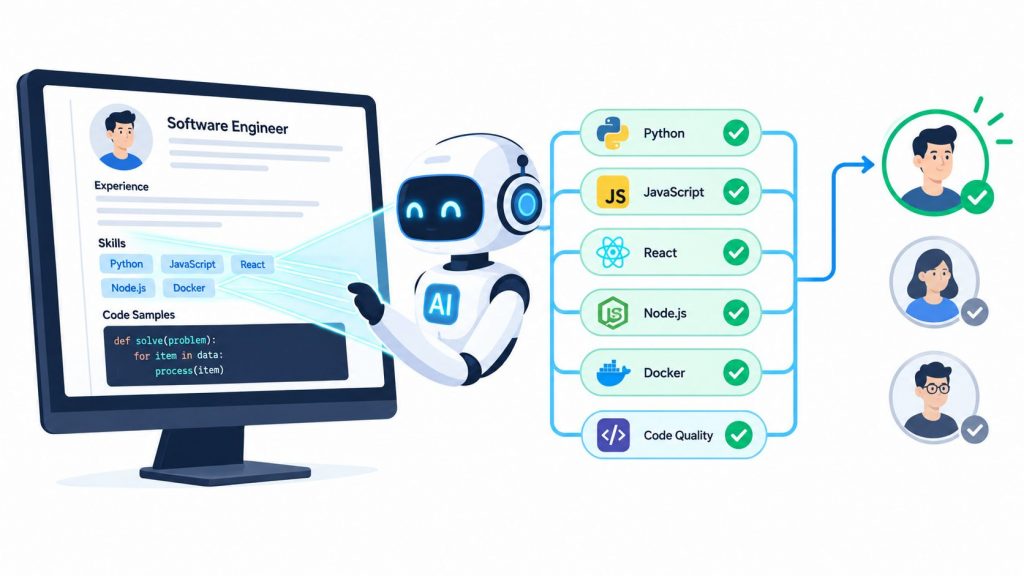



You've opened a software engineer search for a practice-management platform, patient communication system, or internal automation project. Applications arrive quickly, but your hiring manager has limited time and even less room for a false negative. A résumé that looks thin may hide strong experience with an unfamiliar stack, while a polished document may just repeat the right keywords.
AI résumé review can help you manage volume, but it should be the first filter, not the hiring decision. The strongest workflow uses AI to extract skills, compare role evidence, flag uncertainty, and create a consistent shortlist. Human reviewers then validate technical ability, communication, judgment, and the candidate's ability to work safely around healthcare operations.
That distinction matters for medical practices. A software engineer supporting an EHR integration is not being assessed in the same way as a virtual receptionist, scheduler, or billing specialist. The role may be technical, but the surrounding environment includes patient privacy, access controls, uptime expectations, and operational consequences. This guide explains how AI resume review works, where it fails, how to audit bias, and how to combine automated screening with structured human assessment.
Table of Contents
Manual résumé review breaks down when a specialized role attracts more applications than a practice manager or technical lead can examine carefully. Searching for evidence of backend development, cloud infrastructure, security practices, or healthcare integration experience across inconsistent documents takes time. The pressure becomes greater when the organization needs to keep patient-facing operations running while hiring.
That pressure explains the move toward automation. A summary of AI resume screening describes the technology as a way to compare résumé content with role requirements and surface relevant evidence. In the 2024 ResumeBuilder survey cited in the available research, 82% of participating business leaders said their companies used AI for résumé screening, while 51% used AI somewhere in hiring more broadly. The same source reports that, among organizations already using automation or AI in hiring, résumé screening was the most common application at 44%. Research on software-engineer demand provides useful context for why technical recruiting teams often need a repeatable first filter rather than an entirely manual process.
An AI reviewer generally converts an unstructured résumé into structured signals. Those signals may include:
That extraction increases processing capacity. It doesn't prove that a candidate can design a reliable system, explain a trade-off, or protect sensitive information. It also doesn't prove that a missing keyword means missing competence.
The limitations are visible in the same SHRM-related reporting. Nineteen percent of organizations using automation or AI in hiring said their tools had overlooked or screened out qualified applicants. That risk is material for global technical recruiting because equivalent skills may appear under different titles, languages, résumé formats, or employment patterns. A candidate who built containerized deployments might describe the work through platform outcomes rather than naming Kubernetes.
Practical rule: Use AI to decide which applications deserve careful attention first. Don't use it to decide who is qualified without a human validation stage.
A résumé parser doesn't read a document exactly as an experienced engineering manager does. It identifies text, sections, entities, and relationships, then estimates how those elements correspond to a job description. The quality of the result depends on document structure, terminology, the model's taxonomy, and the evidence available in the résumé.

A useful way to understand AI résumé review is to follow the information through five stages:
This process is helpful for obvious matches. It becomes less reliable when the job description is vague or the résumé describes outcomes rather than tools. A software engineer may mention reducing deployment friction without naming Kubernetes, or describe high-performance services without stating Rust. A keyword-only system can rank that person below an applicant who lists technologies without demonstrating meaningful use.
Technical terms often carry different levels of evidence. “Familiar with Kubernetes,” “managed Kubernetes clusters,” and “designed a multi-region deployment platform” shouldn't receive the same interpretation. AI can identify the term, but a reviewer still needs to assess depth, recency, ownership, and context.
Use developer skills assessment guidance after résumé parsing, not instead of it. A skills assessment can test whether the candidate can apply the claimed knowledge to a realistic problem. Tools intended for recruiting operations, including an AI sales agent for recruiters, may help teams manage repetitive communication or workflow tasks, but automation around candidates shouldn't replace evidence-based evaluation.
For a medical practice, the job description should also distinguish technical requirements from workflow requirements. An engineer working on patient scheduling software may need integration experience, secure development habits, and clear communication with nontechnical staff. AI can surface those signals. It can't reliably infer how the person will respond when a production issue affects appointment access.
Buying a résumé-screening product doesn't transfer responsibility for the selection process. The employer still owns the criteria, the workflow, the records, and the outcome. The EEOC's guidance on employment discrimination and AI expressly identifies résumé keyword screening as an AI-supported activity covered by federal employment-discrimination protections.
Those protections apply when an automated system screens or ranks applicants based on protected characteristics, including race, color, religion, sex, national origin, age, disability, or genetic information. The risk doesn't require discriminatory intent. A keyword rule, ranking feature, or proxy can disadvantage qualified people even when the employer believes the process is neutral.
A 2025 Brookings analysis tested three large language models across nine occupations and 27 discrimination comparisons. Resumes with male and female names were selected at equal rates in only 37% of tests. In the remaining comparisons, male-associated names were favored 51.9% of the time, while female-associated names were favored 11.1% of the time, with notable intersectional effects affecting Black men. These results come from Brookings' analysis of gender, race, and intersectional bias, and they show why a professionally identical résumé can receive a different ranking when seemingly minor signals change.
Your review process should therefore include:
The EEOC and Department of Justice guidance on AI and disability discrimination also emphasizes that employers can face ADA risk when a third-party tool disproportionately screens out people with disabilities. Résumé parsers may mishandle employment gaps, nonstandard formatting, assistive-technology output, or disability-related career paths.
Use hiring best practices for a defensible process as an operating discipline, not as a substitute for advice from qualified employment counsel. For a medical practice, document why each criterion is job-related and provide an accommodation route when an applicant needs one.
A high accuracy score can create false confidence if the test data doesn't resemble your applicants. Synthetic résumés are clean, consistent, and easy to label. Real applicants use different formats, describe the same work with different vocabulary, change careers, take breaks, work across countries, and combine formal employment with freelance or open-source projects.
One résumé-screening study reported 100% accuracy, precision, recall, and F1 for several classifiers, but it also cautioned that synthetic data lacks the ambiguity and variability of real hiring decisions. The study's abstract and research record supports a narrower conclusion. A perfect benchmark result may show that a classifier handled an artificial dataset, not that it can identify the right applicants in your hiring environment.

Many organizations evaluate a new tool by comparing its recommendations with historical recruiter decisions. That is easy to measure, but it can reward the wrong behavior. If prior recruiters preferred a particular school, job title, location, or uninterrupted work history, a model that copies those preferences may achieve strong agreement while preserving old bias.
A useful validation set should include representative historical and current résumés across the markets where you recruit. It should also separate two questions:
Those questions aren't interchangeable. A medical practice hiring an engineer for an EHR integration should test evidence of integration design, debugging, documentation, security judgment, and collaboration. It shouldn't ask the model to infer reliability, empathy, accent quality, or cultural fit from résumé prose.
Change the order of applications and observe whether rankings move. Test equivalent résumés with different names, school references, employment gaps, locations, and formatting. Measure precision at the review cutoff, recall, false-negative rates by role, and agreement between model recommendations and expert adjudication.
A 2025 study of automated résumé screening concluded that synthetic data can support initial experimentation but needs realistic and diverse data for rigorous fairness evaluation. Another experiment involving more than 2,000 observations found that ChatGPT screening reproduced established biases and raised concerns about the order in which résumés were presented. The Iowa State research record on automated resume screening reinforces the need for monitored decision support rather than autonomous rejection.
Screening answers, “Which applications should we examine first?” Validation answers, “Can this person perform the work, communicate clearly, and operate within our constraints?” Confusing those questions is the main reason a fast résumé workflow becomes a risky hiring workflow.
A keyword-only process is inexpensive to launch. It can identify direct matches for terms such as Python, React, PostgreSQL, or Kubernetes, but it may reward résumé formatting and vocabulary over actual ability. It also creates pressure to write increasingly broad job descriptions, which makes ranking less meaningful.
A hybrid process takes more coordination, but it gives each stage a clear job:
| Stage | AI contribution | Human responsibility |
|---|---|---|
| Intake | Extract skills, dates, titles, and project signals | Define job-related criteria |
| First filter | Rank likely matches and flag uncertainty | Review borderline and nontraditional profiles |
| Technical validation | Organize evidence for assessment | Use structured interviews and work samples |
| Operational review | Surface availability, location, and communication signals | Confirm schedule, access, and role boundaries |
| Decision | Record recommendation and confidence | Make and document the progression decision |
Start with a narrow scorecard. For an engineer supporting clinical software, list the capabilities that affect the work, such as API integration, testing discipline, access-control awareness, incident communication, or experience working with regulated workflows. Separate required evidence from preferred evidence so the model doesn't treat every phrase as equally decisive.
Then use AI for high-recall discovery. Ask the system to identify supporting evidence and missing evidence, not to label the person as good or bad. A candidate who appears weak because the résumé says “healthcare interoperability” instead of naming a particular standard should receive an uncertainty flag and human review.
The next stage should include structured technical assessment. Depending on the role, that may involve a debugging exercise, architecture discussion, code review, integration design task, or written explanation of how the candidate would handle a production issue. The assessment should reflect the actual work and should not imply that an administrative assistant or virtual receptionist performs licensed clinical duties.
A vetted talent platform can absorb more of the validation process than a résumé scanner alone. HireDevelopers.com uses automated résumé and LinkedIn screening as one part of a developer-vetting workflow that also includes live soft-skills and English assessments and technical interviews. For a practice that needs engineering support but doesn't have an internal technical recruiter, that structure can reduce the number of unqualified applications reaching the hiring manager.
It doesn't remove your obligations. You still need to define access, responsibilities, working hours, data exposure, and the evidence required for progression. For workers handling protected health information, remote access itself isn't automatically a HIPAA violation, but a staffing company or worker acting on behalf of a practice may be a business associate. The practice generally needs written satisfactory assurances, normally through a Business Associate Agreement, along with appropriate access and incident controls. Medical virtual assistant compliance guidance explains why the agreement should be matched with role-based access, training, authentication, breach reporting, and termination procedures.
AI résumé review is valuable when it handles the repetitive first pass. It can extract technical evidence, normalize terminology, rank applications, and identify gaps for a human reviewer. It cannot reliably validate engineering depth, infer job performance from résumé similarity, or remove an employer's responsibility for fair selection.
Build the workflow around AI screening, bias testing, human review, structured technical assessment, and documented decisions. Use realistic and diverse evaluation data, test false negatives, review uncertain profiles, and keep technical criteria separate from assumptions about personality or cultural fit. For medical practices, add privacy and access controls before a remote worker can reach practice systems or protected health information.
If you're hiring software engineers or remote healthcare staff and want help creating a staged, evidence-based shortlist, book a consultation with a vetted talent team. Describe the role, required schedule, technical or administrative duties, and privacy constraints so the first candidate review reflects the work you actually need done.

Wondering what is technical leadership? Discover the essential skills that transform great engineers into the influential leaders your team needs.


You're probably reading this because a perfectly normal engineering disagreement went feral. It started with a pull request. Somebody wrote “I wouldn't do it this way.” Somebody else read that as “you're an idiot.” Then Slack got spicy, the standup got awkward, and now half the team is discussing architecture while the other half is...

Stop using MongoDB interviews to reward memorization. Use them to expose judgment. A candidate who can recite "document-oriented NoSQL database" tells you almost nothing. A candidate who can explain why a bad shard key creates hotspots, why an innocent query turns into a collection scan, or why indexing the wrong field wrecks write performance is...


