How to Hire Dedicated PHP Developers the Right Way

Victor
Posted on 15 October 2026



PHP is still a practical hire because 69.7% of websites with a detectable server-side language use it, and it's still present on 64.6% of the top 1 million sites. If your stack is on PHP 8.2, 8.3, or 8.4, don't hire for syntax alone, hire for someone who can run a paid work sample against your real framework, then defend the code in a live review.
That's the decision facing many teams right now. You're not shopping for a developer who can write a neat controller in isolation. You're trying to find someone who can safely work inside an existing estate, keep production stable, and move a long-lived codebase forward without creating cleanup work for the rest of your team. That matters even more when the application already carries business logic, integrations, legacy dependencies, and release pressure.
For medical practices and healthcare organizations, that same logic applies to internal software and patient-facing systems. You need a developer who can handle maintenance, upgrades, performance, security, and handoff discipline, not just new feature tickets. If you want a broader framework for attracting and evaluating talent, talent strategy advice from Benely is a useful reference, and this guide to dedicated development teams can help you compare team-shape decisions before you post the role.
Table of Contents
A dedicated PHP developer is part of the operating team. They should join standups, review pull requests, own pieces of the codebase, and be accountable for what reaches production. If you hire for short-term output, you usually get short-term thinking, and that is how legacy systems stay fragile.
Treat the role as an operations decision, not a staffing checkbox. You are bringing in someone to keep a live estate healthy, usually one that mixes older code, newer frameworks, APIs, databases, and release habits that were never documented cleanly. For teams that need help deciding between a single engineer, a pod, or a longer-term extension of their own staff, this overview of dedicated hiring models is the right place to start.
Before you open the role, get four people aligned. The engineering lead sets the technical bar. The product owner defines the backlog reality. Finance sets the commercial guardrails. Security or compliance decides what access, logging, and review rules are required.
Without that alignment, the job description drifts. One person asks for framework depth, another assumes broad backend skill, and a third wants modernization support. That is how teams hire the wrong developer and only find out after a few painful sprints.
Practical rule: write down what the developer will own in the first 90 days, then use that list to shape the interview.
For a medical practice, that may be a billing portal, a patient intake workflow, or an internal admin app that has to stay up during business hours. Describe the actual work, not a wish list. If the codebase is old, say so. If releases are delicate, say so. If the developer must work through ambiguous legacy code and still ship safely, say that plainly. For broader support on role design and staffing structure, talent strategy advice from Benely is a useful reference.
Most PHP hiring fails because companies screen for an ideal stack and ignore the one they run. You need someone who can read procedural code, modern object-oriented code, framework conventions, and the gaps between them. That matters even more when several people have touched the estate over time and nobody owns the technical story.
A strong candidate should talk clearly about upgrade paths, dependency risk, database changes, and release sequencing. If they only talk about greenfield work, they are a poor fit for a mature production environment. For healthcare organizations and other regulated teams, that difference is not academic. Patient-facing tools and internal systems cannot afford casual ownership.
A company does not hire PHP talent because the language is trendy. It hires because the estate already exists, it earns money, and someone has to keep it running while it is modernized without breaking production. PHP still sits behind a large share of detectable server-side websites, and it remains present across heavily used sites as well. That is enough to keep the hiring market real. W3Techs PHP comparison data
The candidate pool is real too, but it is uneven. The 2025 Stack Overflow Developer Survey shows PHP in active use by a meaningful slice of developers, yet active use is not the same thing as safe ownership of a live system. One person may know WordPress. Another may know Laravel. Another may have enough syntax familiarity to talk well in an interview and still be weak on migrations, testing, release discipline, and rollback planning. Syntax is cheap. Production judgment is the scarce skill.

Treat the hire as an operations problem. The question is not whether someone can write PHP. The question is whether they can keep a business-critical system healthy while they upgrade it, untangle old dependencies, and prevent small changes from turning into production incidents. AI has changed how code gets produced, but it has not removed the need for a developer who can review output, spot weak assumptions, and own the result.
Teams do not need more code output. They need fewer risky releases.
The strongest PHP hires are maintenance-minded and steady under pressure. They can move a runtime forward, clean up package risk, improve performance, and leave the codebase easier to support the next time around. That matters when the application is a patient portal, a claims workflow, or a scheduling engine, because those systems punish sloppy ownership. It also matters in the broader market, where software engineer demand keeps pushing companies toward people who can support what already exists, not just build something new.
Write the job brief around the actual estate. Name the framework, version, database, and ownership scope. If you post “PHP developer” and stop there, you will attract noise. If you post “PHP 8.3 developer for a Laravel application with API and legacy maintenance responsibilities,” you will get a far better fit.
The same rule applies to the interview. Ask about the codebase you already run, the runtime you need to keep alive, and the upgrade work that cannot be deferred forever. That is how you turn market demand into a hiring decision that protects production instead of just filling a seat.
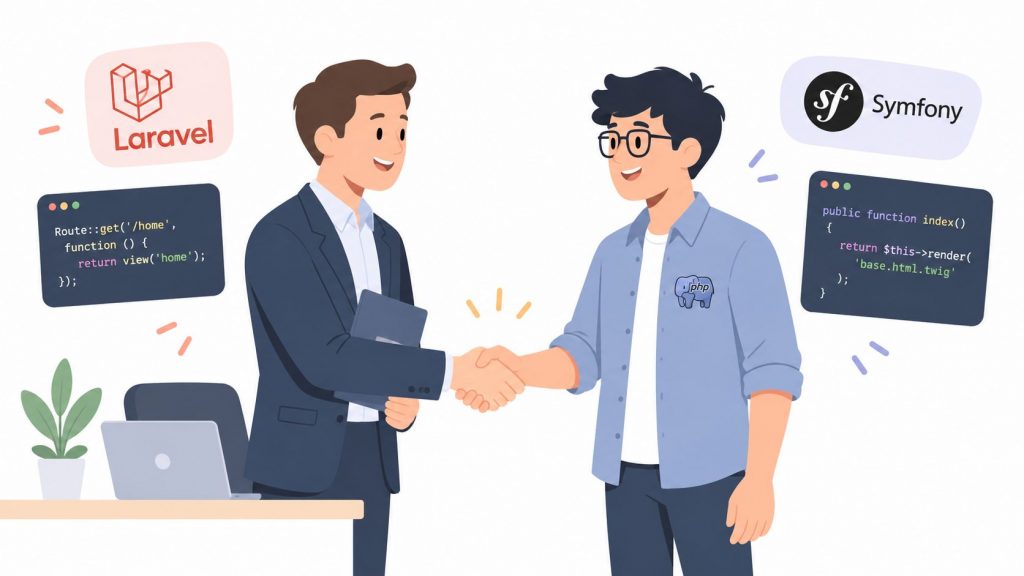
Your stack definition should drive the hire, not the other way around. A candidate who is strong in Laravel might still be the wrong choice for a long-lived Symfony estate, and a WordPress specialist may be poor fit for a custom API platform. If you match the wrong depth to the wrong codebase, you'll spend the first few months compensating for gaps instead of shipping.
The version matters just as much as the framework. PHP has had multiple major transitions over time, and current support windows mean your existing runtime should influence whether you need a feature developer, a migration engineer, or both. PHP's supported versions page is the source to check before you make that call. If your application is nearing end of life on its current branch, hire for upgrade skill, not just feature velocity.
| Stack | Best fit for | Depth to test for | Common hiring trap |
|---|---|---|---|
| Laravel | Fast-moving application work, APIs, admin panels, service layers | Routing, Eloquent, queues, testing, deployment discipline | Hiring for “Laravel familiarity” without testing database or production judgment |
| Symfony | Longer-lived enterprise systems, modular architectures, strict conventions | Dependency management, service containers, version upgrades, maintainability | Assuming framework knowledge alone means modernization ability |
| WordPress or Drupal | Content-heavy sites, editorial workflows, extension-heavy systems | Plugin risk, updates, theming boundaries, security hygiene | Bringing in an app developer who doesn't understand CMS operations |
| Raw PHP or older custom code | Legacy modernization, incremental refactors, brittle production systems | Reading old code, safely extracting services, version upgrades, regression control | Hiring only for new development when the real need is stabilization |
Many teams go wrong this way. They hire for the future they wish they had, then put that person inside the codebase they have. A better approach is to map the backlog to the stack and name the maintenance burden openly.
If your backlog includes API work, database tuning, and upgrade sequencing, the candidate needs more than framework surface area. If the system has a lot of plugin or package dependencies, the person should know how to inspect risk before the next release. If the team expects them to help with modernization, they should be able to explain how they'd move old code forward without a full rewrite.
For hiring teams that want external help finding that kind of profile, engineering recruitment with We Are Distributed is a useful comparison point because it frames backend hiring around actual delivery needs rather than generic language filters. If you're evaluating vendors or internal recruiters, use the same standard: stack specificity, version specificity, and maintenance responsibility.
Skip the trivia. A candidate who can recite PHP syntax but can't safely modify a real endpoint is not the hire you want. The screen that predicts production success is a short paid work sample, followed by a live technical review where the candidate explains choices, defends trade-offs, and responds to change.
Start with a small assignment that mirrors your actual stack. Ask the candidate to implement a versioned REST endpoint, validate input, use parameterized queries, add authorization, write automated tests, and include a short README that explains deployment assumptions. Keep it narrow enough to finish in a few hours, but realistic enough to show how they think.
If you need a ready-made structure for this step, this developer skills assessment resource is a helpful reference for shaping a fair but demanding screen. For a broader perspective on why work samples outperform résumé-led screens, technical hiring work sample assessments is worth reading once, then adapting to your own environment.

A good sample should score architecture, security, testing, debugging, communication, and domain understanding separately. Give security heavier weight than raw completion. A developer who ships a working endpoint but leaves obvious authorization or injection gaps should not pass just because the code runs.
A simple rubric works better than a vague feeling:
Ask this verbatim: “Tell me about a PHP production incident you handled and what you changed afterwards.”
That question tells you more than an algorithm exercise. You're listening for ownership, not heroics. The best answer usually includes what broke, how they diagnosed it, what they changed, and how they reduced the chance of the same issue recurring.
If the candidate says they've worked in PHP for years, ask them to walk through a version upgrade or a framework migration. Don't let them stay abstract. You want to hear how they'd protect compatibility, handle dependencies, sequence deployment, and roll back safely if something goes wrong.
That matters because legacy work is where many PHP teams spend significant time. A developer who can only build new features in clean code will struggle in the systems most organizations already own. If the role includes modernization, make that explicit in the interview and score for it directly.
Choose the engagement model based on the shape of the work, not on habit. A dedicated full-time developer fits when the backlog is steady and the codebase needs ongoing ownership. Team augmentation works when your internal engineers need extra capacity but still control the technical direction. A milestone-based engagement makes sense when the deliverable is narrow and acceptance criteria are easy to define.
The contract matters as much as the staffing model. Use month-to-month flexibility or milestone-based terms with explicit acceptance criteria. Require IP assignment, access boundaries, a clear escalation path, and a maintained runbook. If the developer is expected to touch production, you also want overlap hours, recorded demos, pull requests, and a release path that includes staging approval before production.
The U.S. Bureau of Labor Statistics software developer page gives a useful comparison point when you weigh a full-time local hire against a dedicated remote engagement. It reports a median annual wage of $135,980 for software developers in May 2025, and it projects 10% growth from 2025 to 2035 for software developers, quality assurance analysts, and testers, with about 106,100 openings per year across that group during the decade. Those figures are not PHP-specific, but they're a solid benchmark.

Don't compare only hourly rate. Compare the full cost of the hire, including recruiting, payroll, equipment, management time, paid leave, and compliance administration. A cheaper rate can still be expensive if the developer needs constant oversight or creates release risk. For a medical practice or healthcare organization, operational stability is worth more than a low sticker price.
This is also where a platform like HireDevelopers.com can fit as one option. It offers vetted developers across stacks and engagement models, including dedicated, part-time, and team-based arrangements. Use that kind of service as a shortlist source, not as a substitute for your own technical review.
A clean contract should cover:
If those items are missing, the engagement can look efficient on paper and still become hard to operate. That's especially dangerous in systems where uptime, release discipline, and privacy controls matter.
If you want to hire dedicated PHP developers the right way, stop hiring for generic PHP knowledge and start hiring for the stack you run. Name the version, name the framework, name the maintenance burden, and make sure the candidate can support both delivery and modernization. The most valuable person in this role is the one who can improve a real production system without turning it into a rewrite project.
This week, write a stack-specific brief, design a paid work sample plus live review, and choose the engagement model that matches your roadmap. If you want help building a pre-vetted shortlist instead of starting from zero, HireDevelopers.com is one place to look, but the screening standard should still be yours.

Let's cut to the chase. You have a killer product vision, but your budget doesn't quite match the six-figure salaries of senior developers in your city. You’ve heard about offshore software development services, and maybe some of the horror stories that come with them. But here’s the secret: when done right, this isn't about finding...

Let's be honest. You have data stuck in one place, and it needs to be cleaned up and moved somewhere else. This is the world of ETL—Extract, Transform, Load—and it used to be a clunky, expensive nightmare. So You Think You Need a Data Pipeline If you’ve ever stared at a six-figure quote for an...

Hiring Node.js developers used to be a straightforward exercise, look for JavaScript fluency, an Express app or two, and maybe a GitHub profile that showed some API work. That advice is now too shallow for modern backend teams. In 2026, the key question is whether a candidate can work in a TypeScript-first, production-oriented Node.js stack...


