How to Hire .NET Core Developers

Victor
Posted on 12 October 2026
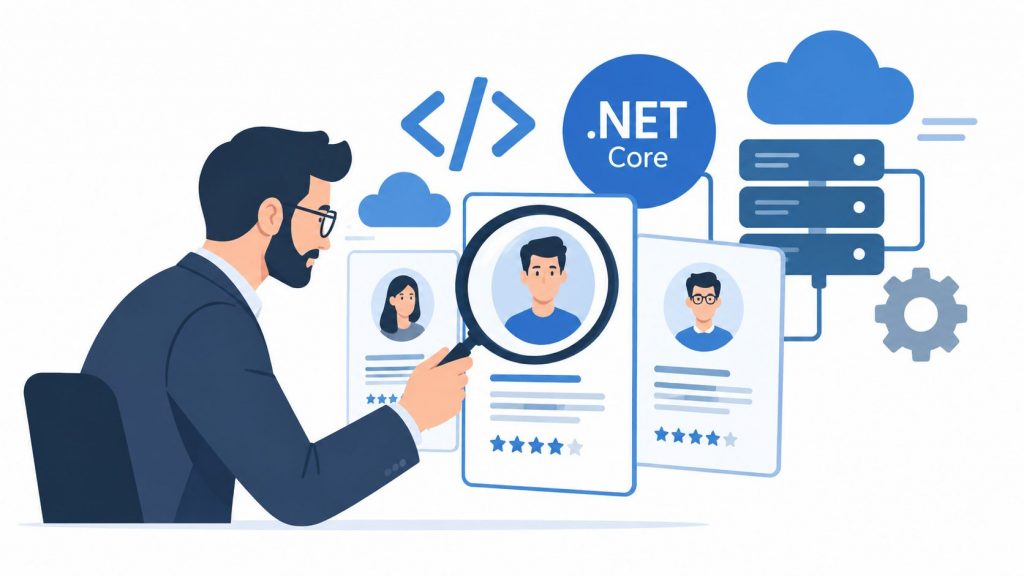



If you want to hire .NET Core developers, don't start with “Who knows C#?” Start with “Who can keep a production API healthy after the first deployment?” That shift matters in medical practices, where scheduling, insurance workflows, patient communication, and security don't care whether a developer can pass a syntax quiz. They care whether the person can ship code that stays supportable, observable, and safe to change.
A modern .NET hire needs more than language fluency. The platform evolved from .NET Core into today's unified .NET stack, and Microsoft's lifecycle model now makes version planning part of the job, not a nice-to-have. A good candidate should understand framework scope, production debugging, migration planning, and the trade-offs behind performance and deployment decisions. A weak candidate may still write working code, but they'll struggle when a practice needs a supported upgrade path, better observability, or a safe rollout.
For U.S. medical practices, that difference shows up quickly. A portal for appointment requests, a claims workflow, or a referral intake app can look fine in staging and still become fragile in production if the developer doesn't think about cancellations, database behavior, telemetry, or support windows. The right screening process will surface that judgment early.
Table of Contents

The phrase .NET Core developer means something different now than it did in 2016. Microsoft launched .NET Core on June 27, 2016 as a cross-platform implementation, then moved through .NET Core 1.1, 2.0, 2.1 LTS, 3.0, and 3.1 LTS before dropping “Core” with .NET 5 on November 10, 2020 and unifying the platform for web, cloud, desktop, mobile, and other workloads. Microsoft's release cadence now centers on annual major releases in November, with versions classified as Standard Term Support or Long Term Support, so version awareness is part of production work, not trivia. That history is on the Microsoft lifecycle page for .NET and .NET Core product support.
For a medical practice, that evolution changes the hiring brief. A developer maintaining a legacy patient portal on older .NET Framework code may need migration discipline. A developer building a new telehealth scheduling layer may need cloud-friendly ASP.NET Core, container awareness, and API design. Those are different skills, even if both candidates say they “work in .NET.”
Practical rule: hire for the runtime you actually run, not the one the candidate enjoyed years ago.
A practice that still depends on older internal tools should screen for migration experience, package compatibility, and supportability. A team building new services should ask for experience with REST APIs, dependency injection, middleware, testing, and deployment habits. If the developer will touch claims workflows or patient messaging, their judgment around authentication, logging, and failure handling matters more than whether they've memorized language syntax.
That's why broad branding can mislead. A “.NET developer” who once lived in Web Forms may not be ready for containerized APIs, and a modern backend engineer may have little interest in maintaining a legacy monolith. If you need broader engineering maturity, a useful companion resource is HiredBySkill's guide to self-taught developer skills employers want, which is a good reminder that practical capability often matters more than a neat résumé title.
Medical workflows are unforgiving. If an appointment request queue or insurance verification service breaks, staff feel it immediately, and patients usually do too.

A technical screen for .NET hires should prove production readiness, not reward people who can recite framework keywords. The strongest assessments focus on whether a candidate can keep a system supportable after it goes live. That means checking how they handle runtime behavior, failure paths, and trade-offs that show up after the first release.
The process works best in four steps. Confirm framework scope. Give a time-boxed implementation exercise. Review architecture decisions. Then inspect code quality under conditions closer to real operations than a whiteboard interview. For a ready-made structure, see this developer skills assessment framework and adapt the score areas to your stack. For broader assessment design patterns, designing an AI testing framework is a useful reference because structured evaluation beats intuition in software hiring too.
Start with the stack you care about, ASP.NET Core, dependency injection, middleware, REST or gRPC, Entity Framework Core, asynchronous programming, authentication, testing, and Docker. Ask them to separate what they have shipped from what they have only studied. A person who has built a patient intake API will answer differently from someone who only followed a tutorial.
A strong exercise is a small API with validation, pagination, structured errors, and automated tests. The goal is to see whether the candidate can produce something maintainable without hand-holding. In a medical practice context, that can be an appointment lookup endpoint or a referral submission service.
Look for cancellation token use, database indexing awareness, concurrency handling, observability, and secure secrets management. Ask the candidate to explain why those choices fit the system. Good engineers usually talk about operational fallout, not just syntax.
A candidate can still look polished and miss obvious failure modes. Watch for synchronous I/O on request paths, unbounded EF Core queries, missing cancellation, insecure authentication, absent integration tests, and no telemetry. Those are supportability problems, not style issues. They tell you the code may run, but the service will be painful to operate.
You can formalize the screen with a simple scorecard.
| Score Area | What Good Looks Like | What Usually Fails |
|---|---|---|
| Runtime fundamentals | Understands async flow, cancellation, and framework boundaries | Knows language keywords but not runtime behavior |
| Web architecture | Designs APIs with validation and error handling | Builds endpoints that work only in happy-path demos |
| Data access | Uses EF Core carefully, understands query shape | Ships unbounded queries and vague repository layers |
| Cloud operations | Thinks about deployment, secrets, and logging | Treats production as an afterthought |
| Communication | Explains trade-offs clearly | Answers in jargon or talks around the question |
The easiest mistake is letting résumé depth substitute for proof. For any team that supports medical operations, that shortcut gets expensive fast.
Benchmarks get oversold in hiring. A candidate says a platform is “fast,” quotes a number, and the interviewers move on. That's too loose for production work. Microsoft's .NET 8 ASP.NET Core benchmark discussion reports 18% TechEmpower JSON improvement and 24% Fortunes improvement versus .NET 7, while the same write-up shows Native AOT reducing startup time from 156 ms to 48 ms, application size from 92.6 MB to 10 MB, and working-set memory from 96 MB to 41 MB. Those figures are useful, but only inside the workload and deployment conditions they describe, which Microsoft explains in its ASP.NET Core in .NET 8 announcement.
That's the right way to assess performance claims in an interview. Ask how the candidate would reproduce a meaningful test, then listen for workload shape, request mix, hardware, warm-up, and latency targets. If they only talk about raw throughput, they're probably optimizing for the wrong thing. In a medical practice, appointment search latency during morning peaks matters more than a bragging-rights benchmark number.
Real systems depend on database latency, serialization behavior, auth middleware, logging, and downstream services. A candidate who understands that can explain why a fast benchmark doesn't guarantee a fast patient portal. If they can't, they may ship code that looks impressive in isolation and disappoints in production.
Useful filter: ask what would make a benchmark meaningless for your workload. Good engineers usually have an answer.
AI adds another layer of confusion. The 2025 Stack Overflow Developer Survey reports that 84% of respondents use or plan to use AI tools in development, and 51% of professional developers use them daily, according to the survey's broad global results at Stack Overflow's 2025 Developer Survey. That doesn't mean an AI label on a résumé predicts better engineering judgment. It just means the tool is common.
Microsoft's .NET 9 documentation also points to abstractions for large and small language models, embeddings, vector stores, and middleware, which shows that AI work is becoming part of the .NET stack rather than a side hobby. For a medical practice, the hiring question isn't whether a developer can mention AI. It's whether they can safely evaluate generated code, protect sensitive data, design retrieval workflows, manage latency and cost, test nondeterministic behavior, and fall back cleanly when an AI service fails.
A backend engineer who can integrate model APIs without making the application fragile is useful. Someone who merely knows the buzzwords isn't. In regulated or patient-facing environments, that distinction is worth more than a trendy résumé line.
An application can keep running after support ends, but running and being supportable are different states. Microsoft says applications built on .NET 8 and .NET 9 will continue to run after end of support, while servicing updates, security fixes, and technical support stop. Microsoft also says .NET 8 and .NET 9 reach end of support on November 10, 2026, and that .NET 8 had a 36-month LTS support window from its November 2023 release.
For a medical practice, that distinction matters because uptime does not equal supportability. A patient portal can keep loading while security debt, package drift, and maintenance risk build underneath it. That matters as soon as the app handles personal or financial information.
Ask the candidate how they would inventory runtime versions, identify third-party package constraints, stage the upgrade, test authentication and database integrations, and roll back safely if something breaks. You are checking how they think about dependency risk, release windows, and auditability.
A strong candidate will not treat upgrades as an afterthought. They will talk about compatibility, sequencing, and the work needed to preserve service while moving to a supported runtime. If they have handled modernization before, they should be able to explain what changed, what broke, and how they controlled the rollout.
Broader modernization experience helps here. A practical companion resource is the guide to legacy system modernization approaches, because platform upgrades rarely happen in isolation. They usually touch data, auth, hosting, and long-held assumptions.
Don't hire a developer who only knows how to add features. Hire one who can tell you how the system survives the next version change.
The right screening question is simple: can this person keep an app supported, not just alive? In healthcare, that separates a codebase you can maintain from one you are forced to defend.
The best hiring model depends on what's broken. If your medical practice needs steady feature work and long-term ownership, a full-time engineer makes sense. If you're modernizing a legacy intake system or need help with a bounded migration, a contractor may be the cleaner fit. If you need architectural direction for a new platform, you need someone who can design the shape of the system, not just fill tickets.
U.S. labor conditions reinforce the need for precision. The Bureau of Labor Statistics reported a median annual wage of $135,980 for software developers in May 2025 and projected 10% employment growth for software developers, quality assurance analysts, and testers from 2025 through 2035. It also reported approximately 1.7 million jobs in that occupational group in 2025. Those numbers are for the broader market, not a .NET niche, but they show why vague hiring asks usually underperform. The market rewards clarity. The BLS data is available in the software developers occupational outlook.
A senior engineer should handle architecture choices, performance planning, and migration strategy. A mid-level implementer should own defined features, API work, and database changes inside a known architecture. A contractor should solve a specific problem, like a supportable upgrade or an integration gap, without turning into an accidental long-term dependency.
For medical practices, that split matters because a billing workflow isn't the same as a new telehealth platform. One needs dependable delivery inside constraints. The other may need someone who can design the next system layer.
| Role Profile | Essential Competencies | Optional / Niche Skills |
|---|---|---|
| Senior backend engineer | ASP.NET Core, API design, data access, testing, observability, support planning | Azure depth, container tuning, advanced migration work |
| Mid-level developer | Feature delivery, EF Core, authentication, debugging, integration testing | Messaging, cloud deployment, performance profiling |
| Migration-focused contractor | Runtime upgrade planning, package compatibility, rollback design, release coordination | New product architecture, long-term roadmap ownership |
For a practical hiring comparison, DataLunix's guide to compare IT managed services vs staff augmentation is useful if you're deciding whether you need outside delivery help or a longer-term extension of your team. If you're comparing employment models more directly, this is also where a clear internal policy on contract vs direct hire keeps expectations honest.
Score candidates separately for runtime fundamentals, web architecture, data access, cloud operations, and communication. Then require evidence for each one through one practical exercise and one technical discussion. That is a much cleaner way to compare people than a general “seems senior” impression.
If you need an efficient sourcing option, HireDevelopers.com lists vetted developers, including .NET and ASP.NET Core talent, as one route for finding pre-screened candidates. Use it as a sourcing channel, not a substitute for your own role-specific assessment.
The scorecard should tell you who can keep the system healthy, not who can talk the most confidently in an interview.
When you hire .NET Core developers, the goal isn't finding the most fluent C# speaker. It's finding someone who can keep a production system supportable, secure, and responsive as requirements change. In a medical practice, that means looking for people who understand lifecycle management, observability, authentication, database behavior, and the practical difference between a working app and a supported one.
The most reliable process is simple: define the exact runtime and workload, use a scenario-based assessment, test migration judgment, and score candidates on production skills instead of résumé breadth. That approach filters out people who can only pass syntax questions and surfaces the engineers who can run healthcare software without creating extra risk.
If you're ready to hire .NET Core developers for a medical workflow, start by tightening your scorecard and interview design. Then compare candidates on supportability, not buzzwords, and use a vetted talent source only after your criteria are clear.
If you need help sourcing pre-vetted .NET talent for a scheduling, billing, or patient-portal project, start with a role-specific brief and request a short list of candidates who've shipped production ASP.NET Core work.

Most SQL interview processes are broken because they reward the wrong behavior. A candidate memorizes the difference between DELETE and TRUNCATE, recites it on cue, and walks out looking sharp. Meanwhile, nobody has learned whether they can untangle a messy join, explain a bad execution plan, or keep a reporting query from chewing through your...

You’re probably reading this with one tab open to Jira, one tab open to Slack, and one tab open to a budget spreadsheet that now feels like a personal attack. A deadline slipped. A “small change” turned into a week of rework. Product says engineering is slow. Engineering says product keeps changing the target. Finance...

Let’s get one thing straight: Agile is the philosophy, and Scrum and Kanban are just two ways to live it. Think of Agile as the decision to get fit. Scrum is your rigid, time-boxed HIIT class schedule. Kanban is a more flexible, go-at-your-own-pace workout plan you track on a whiteboard. This isn't just about picking...


