Hiring AI Developers for Hire: The Practical Guide

Victor
Posted on 8 October 2026
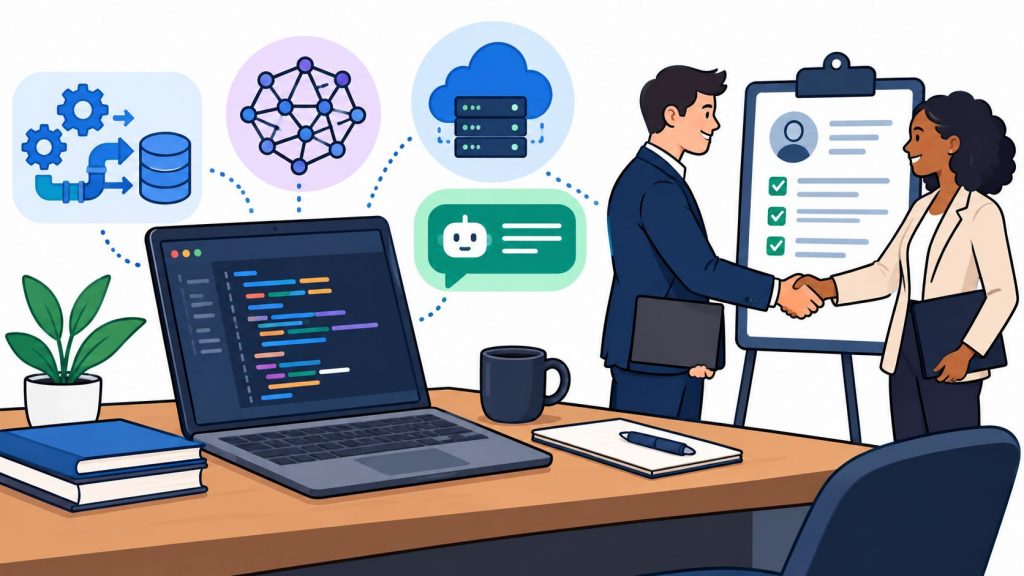



The most popular advice about AI developers for hire is also the least reliable: search for impressive model-building credentials, list every fashionable framework, and choose the candidate who performs best on a coding puzzle. That approach can produce a convincing demo. It doesn't reliably produce a system that survives messy data, changing requirements, security review, production monitoring, or business accountability.
The better question is whether a candidate can convert an AI prototype into a reliable, measurable, governed product. That requires more than Python or model training. You need someone who can define acceptance criteria, inspect data, integrate services, test generated code, manage failure modes, control access, document decisions, and explain trade-offs to people outside engineering.
This guide shows how to define the role, separate ML engineering from adjacent specialties, write a job description that filters for delivery skill, assess candidates who use AI assistance, source globally, and test governance readiness. It also addresses the central hiring trade-off: a research-heavy candidate may build an exciting prototype, while a systems-minded engineer may be better equipped to operate it safely at scale.
Table of Contents
AI development isn't just a coding category. It sits inside a broader labor-market shift that is changing which skills companies need and how they evaluate technical talent. The World Economic Forum's Future of Jobs Report 2025 projects that 22% of today's jobs will be disrupted by 2030, with 170 million new roles created and 92 million displaced. Technology roles, including AI and Machine Learning Specialists, rank among the fastest-growing occupations, while employers expect 39% of workers' existing core skills to change.

The practical consequence is easy to miss. You aren't hiring only for someone who can select a model or write a training loop. You're hiring for a combination of programming, data engineering, cloud operations, cybersecurity, analytical thinking, collaboration, adaptability, and business communication. The WEF identifies AI and big data as the fastest-growing skill category, ahead of networks and cybersecurity and technological literacy, which makes hybrid capability more valuable than a narrow list of certifications.
A polished portfolio often demonstrates that a candidate can make a system work under chosen conditions. It may not show whether they can establish a representative evaluation set, identify data ownership, measure hallucination or failure rates, document limitations, or create a rollback procedure. Those omissions matter because production systems face inputs and operating constraints that a demonstration usually avoids.
The hiring market is also becoming more international. GitHub's 2024 Octoverse report recorded 1.4 million first-time open-source contributors, and Python became its most-used programming language, reflecting the language's role in data science, machine learning, automation, and AI applications. Broader access to talent is useful, but it increases the need for a disciplined scorecard rather than a résumé-led process.
Practical rule: Treat AI fluency as a productivity multiplier, not evidence that a candidate can own production reliability.
If you're comparing specialist sourcing options, a curated market for AI developers for hire can help you investigate candidates with relevant experience. Still, no platform removes the need to define the work clearly and test how a person verifies their output.
The strongest hiring brief starts with the system's bottleneck. If the problem is model quality, seek ML expertise. If it's deployment, observability, or scale, seek MLOps capability. If it's unreliable source data, the right hire may be a data engineer rather than an AI specialist. This distinction prevents you from paying for research skills when the business needs dependable integration.
Calling every specialist an “AI developer” creates an accountability problem. One person is expected to choose a model, clean data, build an API, deploy infrastructure, monitor performance, secure access, and explain business impact. Some senior engineers can span those responsibilities, but most projects need explicit ownership boundaries.
| Role | Primary Focus | Key Responsibilities | Typical Seniority |
|---|---|---|---|
| ML Engineer | Model behavior and application integration | Select and evaluate models, build training or inference workflows, tune performance, create tests, integrate model outputs into products | Mid to senior |
| MLOps Engineer | Reliable operation of AI systems | Build deployment pipelines, manage environments, monitor latency and failures, version models, support rollback and scaling | Mid to senior |
| Prompt Engineer | Behavior of generative-model interfaces | Design prompts and structured outputs, create evaluation cases, test edge cases, improve consistency, document limitations | Mid-level, often combined with application engineering |
| Data Engineer | Quality and movement of data | Build ingestion and transformation pipelines, manage schemas, validate data, control lineage and access, support reproducible datasets | Mid to senior |
An ML Engineer is the right choice when the central problem involves model selection, evaluation, fine-tuning, or integration. That person should be able to explain not only why a model performs well, but also where it fails and how the team will detect that failure.
An MLOps Engineer becomes essential when a prototype must operate as a service. Their work includes deployment automation, monitoring, version control, access management, and recovery procedures. A model that performs well in a notebook still creates operational risk if nobody owns uptime, dependency changes, or degraded outputs.
A Prompt Engineer can be useful for generative applications, but the title shouldn't hide broader engineering needs. Prompt design alone doesn't solve retrieval quality, authorization, data leakage, testing, latency, or user-interface problems. In many teams, prompt work belongs with an AI application engineer who can connect model behavior to the surrounding product.
A Data Engineer addresses the foundation that every other role depends on. They establish reliable pipelines, schemas, validation rules, and lineage. If source records are incomplete, duplicated, stale, or inaccessible, hiring a model specialist first usually produces a faster prototype and a slower failure.
For a deeper comparison between data-focused hiring needs and adjacent technical roles, see this guide to recruiting data scientists. The useful outcome isn't a perfect title. It's a named owner for each production dependency.
A job description should make candidates reveal how they work, not merely confirm that they recognize library names. “Experience with PyTorch” is a weak filter because it says nothing about deployment, evaluation, failure handling, or maintenance. Replace tool inventories with evidence-based responsibilities.
Start with the product problem and its operating conditions. Describe the inputs, users, existing systems, data sensitivity, expected response behavior, and business decision the system supports. Then state what the hire must deliver after implementation, such as a reproducible evaluation process, automated tests, monitoring, documentation, and a controlled release plan.
A stronger requirement might ask candidates to explain how they have:
Ask for a brief account of a system that went beyond a notebook. Candidates should be able to identify what was monitored, who responded to incidents, how tests were run, and which trade-off they would make differently. You don't need confidential code or proprietary data. A clear architecture diagram, redacted test strategy, or explanation of a failed deployment can reveal more than a long portfolio.
Include a paid, time-boxed production exercise when the role affects a critical workflow. Give the candidate a bounded feature or flawed implementation and ask them to define acceptance criteria, add tests, inspect dependencies, identify security risks, and describe rollback. Keep the exercise representative rather than artificially difficult.
A useful posting can follow this structure:
This wording attracts engineers who understand that shipping is only one stage. It also discourages candidates whose experience ends when the demo works.
A conventional coding test measures how quickly someone writes an answer to a constrained problem. AI-enabled development creates a different question: can the engineer determine whether a plausible answer is correct, safe, maintainable, and appropriate for the system?

The Stack Overflow 2025 AI survey found that 84% of developers use or plan to use AI tools, while 46% actively distrust their accuracy. The same verified data includes a controlled experiment in which an AI pair programmer reduced average completion time for one JavaScript HTTP-server task by 55.8%. That result is useful evidence of possible speed improvement on a bounded task, not proof of end-to-end production success.
Give candidates an approved AI-assisted task when that reflects the job. Then assess the work in stages:
This method measures the skill that production teams need most from AI-assisted engineers: responsible verification. Ask applicants to submit reproducible commands, coverage evidence where relevant, a short threat model, and a rollback plan. Those artifacts show whether they can work independently without confusing fluent output with reliable output.
HackerRank's 2025 Developer Skills Report adds a fairness dimension. It found that 73% of developers consider it unfair to lose opportunities to AI-assisted candidates, 66% prefer real-world skills, and 96% believe problem-solving should outweigh memorization. The defensible response isn't to ban assistance automatically. Disclose the rules, permit tools where appropriate, and separately evaluate framing, source verification, debugging, threat modeling, and explanation.
Teams that work with external datasets or automated research may also need a dependable web data API, but the same rule applies to the tooling itself. A developer should be able to validate returned data, handle missing or misleading results, protect credentials, and document what the system does when the source is unavailable.
For a structured interview process, use a developer skills assessment that evaluates implementation and review rather than relying on an isolated algorithm puzzle. The strongest candidate may not be the fastest typist. They're the person who catches the subtle defect before a user does.
Sourcing channels solve different problems. A freelance marketplace may be appropriate for a contained proof of concept. A specialist network can help when you need a narrow combination of AI, cloud, and backend experience. An internal hire makes more sense when the system represents a long-term capability and requires deep organizational context.
Nearshore teams can simplify collaboration when overlapping working hours and frequent communication matter. Offshore hiring may expand access to scarce expertise, but it requires stronger written documentation, handoffs, access controls, and ownership clarity. Lower rates, where available, don't compensate for unclear requirements or weak review practices.
| Option | Useful when | Main advantage | Main risk |
|---|---|---|---|
| Direct employee | You need durable ownership and close product alignment | Deep context and continuity | Longer recruiting and onboarding effort |
| Freelancer | You have a bounded experiment or short-term gap | Flexible engagement | Limited availability for operational ownership |
| Specialist platform | You need screened candidates across regions | Faster access to relevant profiles | You still need role-specific assessment |
| Delivery partner | You need several complementary capabilities | Team coverage across engineering disciplines | Less direct control over individual staffing |
Global hiring also introduces contractual and data-handling questions. Determine who owns intellectual property, where work may be performed, which systems the developer can access, how subcontracting is handled, and what happens when the engagement ends. For sensitive projects, involve qualified legal and compliance professionals before granting access.
GitHub's 2024 Octoverse report recorded 1.4 million new open-source contributors, reported strong growth in markets including the UK, Germany, and France, and found that contributions to generative-AI projects increased 59% year over year. Python became the platform's most-used language. These signals support international sourcing, but open-source activity is evidence of participation, not proof of secure production delivery.
An employer-of-record arrangement may help clarify employment administration in another country. Review the practical implications in this guide to what an employer of record does, then confirm the arrangement with appropriate counsel. An EOR doesn't transfer responsibility for access governance, product security, privacy, or technical supervision.
The NIST AI Risk Management Framework 1.0 provides a useful vocabulary for candidate discussions. Ask how the developer approaches validity, reliability, safety, security, accountability, transparency, explainability, privacy, and fairness. The framework is voluntary and isn't a substitute for legal compliance, but it helps distinguish an engineer who can govern a system from one who can only demonstrate it.
Governance shouldn't appear as a final compliance interview after the technical decision is already made. It belongs in the job definition, work sample, architecture discussion, and reference checks. A candidate doesn't need to recite a framework, but they should show disciplined habits around uncertainty, access, testing, documentation, and escalation.
Ask the candidate to respond to scenarios that resemble the intended system:
Good answers include concrete mechanisms. Look for evaluation sets, audit logs, approval gates, incident procedures, permission boundaries, versioned artifacts, monitoring, and clear ownership. Be cautious when a candidate treats accuracy as the only meaningful metric or claims that a model is safe because it performed well on a demonstration.
Use a sequence that creates evidence at every stage:
Platforms can reduce the time spent finding candidates, but they don't replace this evidence chain. HireDevelopers.com offers a global network for AI, machine learning, and related software roles, with options that include individual contributors and teams. Treat that kind of sourcing route as a way to access profiles, not as a substitute for your own production scorecard.
In regulated industries, consult qualified counsel and compliance professionals about applicable obligations. Framework-based interviewing improves technical judgment, but it doesn't determine whether a particular deployment satisfies every legal, contractual, or sector-specific requirement.
Hiring AI developers is less about finding the most impressive model builder and more about finding the most reliable verifier and production owner. Define the bottleneck before choosing the title, distinguish ML engineering from MLOps and data engineering, and write the role around deployment, testing, monitoring, security, documentation, and measurable outcomes.
Allow AI assistance when it reflects the actual job, but assess the human judgment around it. Require candidates to inspect plausible output, test edge cases, identify threats, explain trade-offs, and describe how they'd respond when the system fails. Use governance questions to test whether they can build something that remains understandable and controllable after launch.
If you're ready to compare qualified profiles, start with a clearly scoped role and a paid, representative assessment through a sourcing platform such as HireDevelopers.com or another vetted channel. Give candidates the constraints they'll face in production, then choose the person who can turn an uncertain prototype into a system your team can operate with confidence.
Define the role, set the verification standard, and request a practical shortlist of AI engineers who can work within your technical and operational constraints. A structured assessment will show far more than a résumé full of frameworks.

Let’s be honest. Most articles on the biggest trends in cloud computing are just a laundry list of buzzwords your IT department already knows. We’re here to talk about the stuff that actually matters—the shifts that determine whether you scale or get stuck footing a five-figure cloud bill for a glorified test server. We’re talking...

You’ve lived this exact moment. Your team has a tidy docker-compose.yml, the app boots, the database connects, and everybody feels productive. Then traffic starts climbing, customers ask rude but fair questions about uptime, and someone says “we should move to Kubernetes” like they’re volunteering your next three weekends. That’s the essence of the docker compose...

When people talk about "python development services," they're not just talking about hiring a coder. They're talking about bringing in a strategic partner to translate a business goal into clean, scalable software. It’s about finding an expert who can do everything from building backend APIs and data scripts to engineering complex AI models. Think of...


